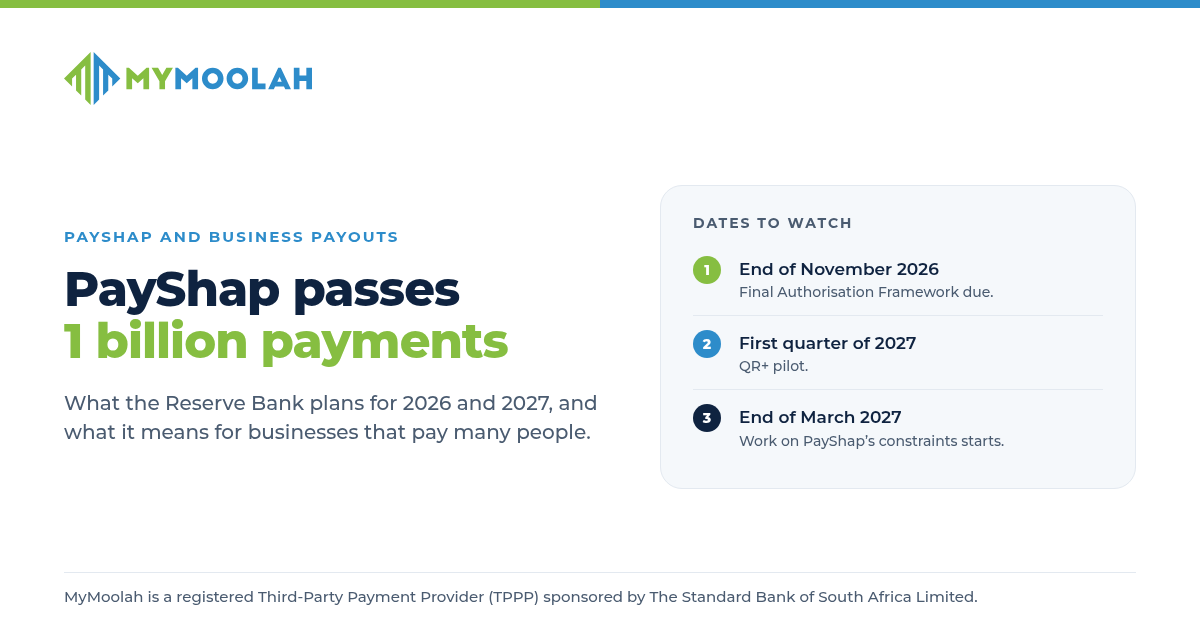

PayShap has passed 1 billion transactions worth more than R1 trillion since 2023, but the Reserve Bank says it is still far from ubiquitous. Its plans for late 2026 and 2027 cover limits, pricing, fraud rules and access for non-bank providers. Businesses that pay many people should review their payout set-up with those dates in mind.
This article is for finance and operations teams at employers, lenders, insurers, and sales and incentive programmes. It summarises what the Governor said on 20 October 2026, lists the dates that matter, and sets out five questions to ask your payout provider. For the full detail, read the speech itself (linked under Sources).
What did the Reserve Bank say about PayShap?
At the SARB Payments Conference in Pretoria on 20 October 2026, Governor Lesetja Kganyago said PayShap had passed 1 billion transactions, with more than R1 trillion moved since it launched in 2023. He called this “only the beginning”. By his figures, PayShap handled about 6% as many transactions as cards last year, and less than 40% of EFT credit volumes.
He named four issues holding PayShap back:
- Parity: transaction limits, features and the user experience differ across participating banks.
- Pricing: institutions have different pricing strategies, and the value to customers is not clear enough.
- Promotion: public awareness is still low.
- Acceptance: PayShap is strongest for person-to-person transfers, and acceptance across the wider network is “not yet broad enough” for everyday payments for goods and services.
He also spoke about closed-loop payment systems. He said the concern arises when they “grow up without opening up”, and that greater scale should bring “stronger obligations to connect”.
Terms used in this article
- PayShap: South Africa’s rapid payment service for low-value payments, available through participating banks. It lets people pay using simpler identifiers instead of bank account details.
- Authorisation Framework: the SARB’s proposed rules that would let appropriately regulated non-bank firms perform specified payment activities.
- QR+: a planned standard for one interoperable QR code that merchants display and customers can pay with the service of their choice.
- Closed loop: a payment system where money can only move between users and merchants inside one network.
What changes are coming, and when?
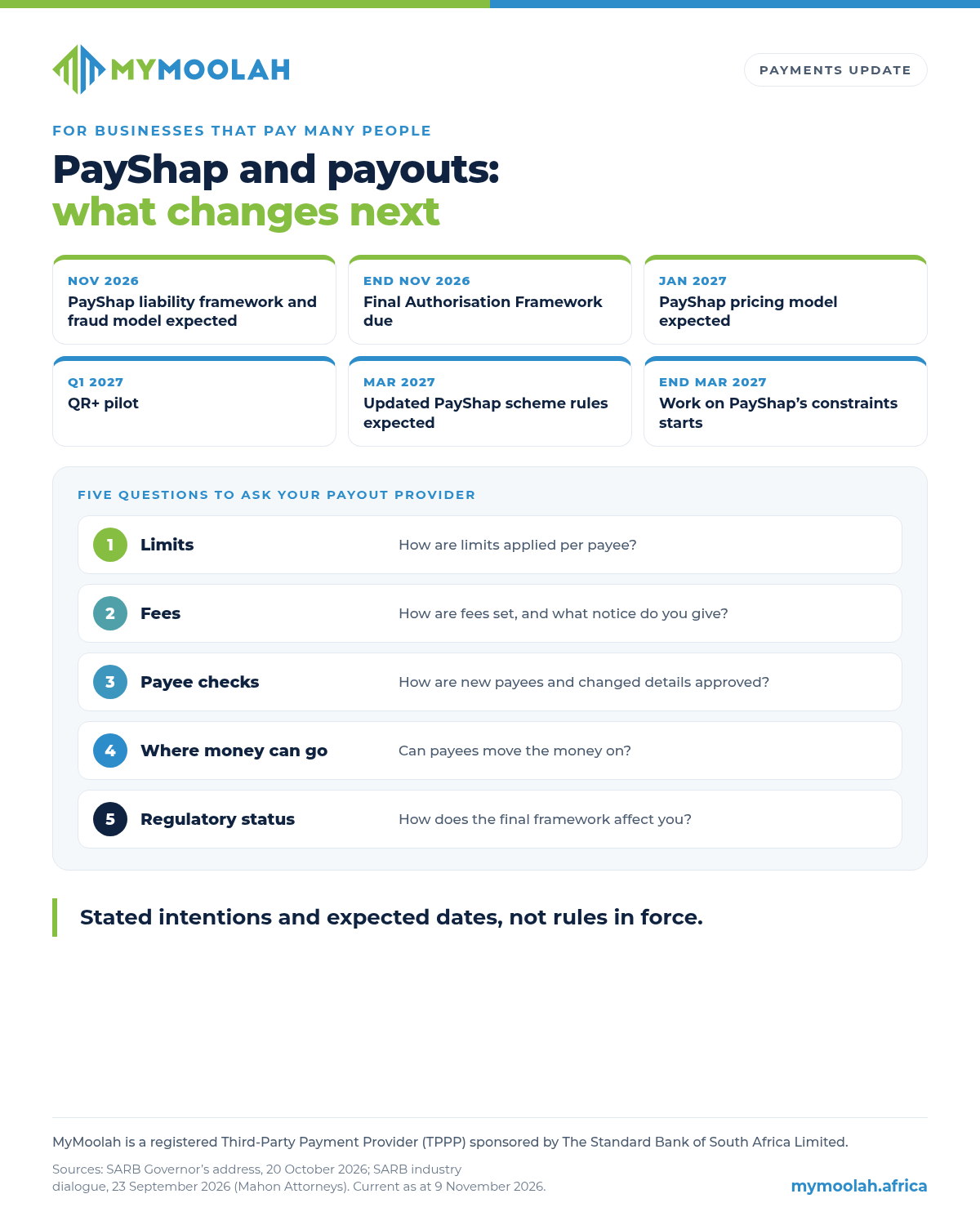
| Expected date | What is planned | Source |
|---|---|---|
| By the end of November 2026 | The SARB intends to publish the final Authorisation Framework | Governor’s address, 20 October 2026 |
| November 2026 | A PayShap liability framework and fraud model | SARB industry dialogue, 23 September 2026 (as summarised by Mahon Attorneys) |
| January 2027 | A published PayShap ecosystem pricing model | SARB industry dialogue (as above) |
| First quarter of 2027 | QR+ pilot | Governor’s address |
| By the end of March 2027 | The SARB aims to start tackling the constraints limiting PayShap adoption | Governor’s address |
| March 2027 | Updated PayShap scheme rules | SARB industry dialogue (as above) |
These are stated intentions and expected dates, not rules in force. As at 10 November 2026, the Authorisation Framework is still a draft, published for consultation in May 2026. Our article on who can move your payouts under South Africa’s payments rules explains the background.
What does this mean for businesses that pay many people?
None of these changes asks you to do anything today. They do give you five things to check before 2027.
1. Plan for limits per payee, not per run
Limits still differ from bank to bank, and wallet limits depend on each payee’s verification level. Build your payout file so a payment above a payee’s limit is flagged before release, or fails cleanly into your exceptions list. Our guide to reconciling bulk payouts covers how to work those exceptions.
2. Check how per-payment fees are set
A PayShap pricing model is expected in January 2027, but the Governor said pricing remains a commercial decision for each institution. Ask your provider how fees are set, how much notice you get of a change, and what a failed or returned payment costs. Compare the total cost of a run, not only the fee per payment.
3. Tighten payee checks before the fraud rules arrive
Whatever the liability framework says, the basics stay the same. Confirm a payee’s details before the first payment. Have one person prepare each run and a second person approve it. Treat any change to a payee’s payment details as a new item that needs approval.
4. Ask where the money can go next
The Governor’s point about closed loops matters for payees. Ask whether the people you pay can move the money on: to a bank account, to other users, or to pay for goods and services. Money that can only be spent inside one network is less useful to the person receiving it.
5. Check your provider’s regulatory status once the framework is final
When the final framework is published, ask your provider how it affects them. Our guide to third-party payment providers explains the terms you are likely to hear.
Where do wallet payouts fit next to PayShap?
PayShap moves money between accounts at participating banks. Wallet payouts are a different route: the business pays from a funded float into a wallet in the payee’s name. Our comparison of bulk EFT, PayShap and wallet payouts sets out when each one fits.
MyMoolah is a registered Third-Party Payment Provider (TPPP) sponsored by The Standard Bank of South Africa Limited. Businesses pre-fund a MyMoolah float with one EFT from their own bank account, then pay people into MyMoolah wallets by portal upload or REST API, as our guide to disbursement platforms describes.
Pay into MyMoolah wallets instantly and free of charge, from your funded float, within each recipient’s verification (KYC) limits.
Each wallet is in the payee’s own name. Until identity checks are complete, a wallet can only receive money, and limits depend on each payee’s verification (KYC) level. Once verified, payees can send money to other MyMoolah wallets, buy airtime, data and electricity, pay by QR at participating major retailers, send to a South African bank account, or cash out with a bank-issued cardless withdrawal PIN, where available. Free between MyMoolah wallets, up to R100,000, within your verification (KYC) limits. Fees apply to bank transfers and cash withdrawals.
Your business can also earn a share of the revenue from the wallets it pays into, under agreed commercial terms.
Information current as at 9 November 2026. This article is general information, not legal or financial advice. Confirm current product terms and wallet limits before you integrate.
Planning your payouts for 2027? Book a payout demo.
FAQ
What is PayShap?
PayShap is South Africa’s rapid payment service for low-value payments, available through participating banks. It launched in 2023 and lets people pay using simpler identifiers instead of bank account details.
How many payments has PayShap processed?
On 20 October 2026, Reserve Bank Governor Lesetja Kganyago said PayShap had passed 1 billion transactions, with more than R1 trillion moved since it launched in 2023.
What is holding PayShap back, according to the Reserve Bank?
The Governor named four issues: different limits and features across banks, unclear or differing prices, low public awareness, and acceptance across the wider network that is “not yet broad enough”.
When will PayShap pricing change?
No date has been set for price changes. A PayShap ecosystem pricing model is expected in January 2027, but pricing remains a commercial decision for each institution.
Is a wallet payout the same as a PayShap payment?
No. PayShap moves money between accounts at participating banks. A MyMoolah wallet payout goes from a business’s funded float into a MyMoolah wallet in the payee’s own name, within each payee’s verification (KYC) limits.
Sources
- Lesetja Kganyago, “Rewiring Payments: Open. Connected. Inclusive.”, SARB Payments Conference, Pretoria, 20 October 2026 (accessed 9 November 2026).
- Mahon Attorneys, “SARB Payments Ecosystem Modernisation: Key Updates for 2026” (summary of the SARB industry dialogue of 23 September 2026; accessed 9 November 2026).
- Prudential Authority, Prudential Communication 10 of 2026, draft Exemption Notice and draft Authorisation Framework for comment, 20 May 2026 (accessed 9 November 2026).