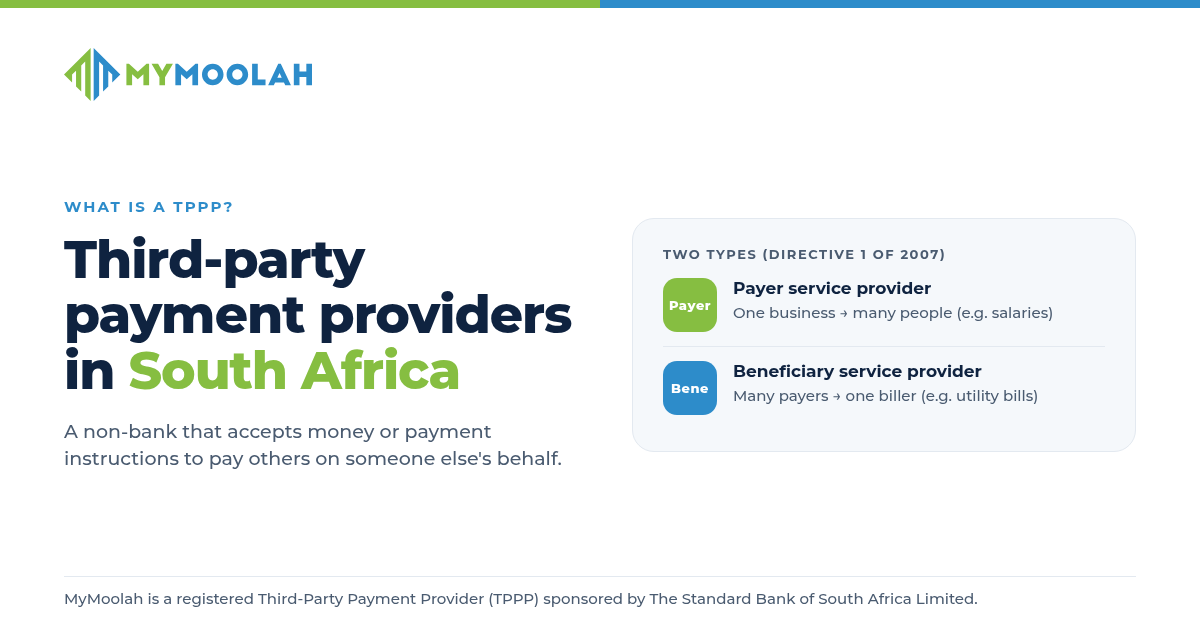

A third-party payment provider (TPPP) is a non-bank that, as a regular part of its business, accepts money or payment instructions from one party to pay others on its behalf. The South African Reserve Bank’s Directive 1 of 2007 splits TPPPs into payer service providers, such as salary payers, and beneficiary service providers, such as bill-payment collectors.
If you are vetting a payout or collections partner, the label “TPPP” is a starting point for due diligence, not a marketing badge. This guide explains what the current directive means, what is changing in draft form, and five questions to ask before you send volume through a provider.
What is a third-party payment provider?
Under Directive 1 of 2007, payments to third persons are the activities of two kinds of non-bank provider. In plain terms, a TPPP sits between a business (or many payers) and the people or billers who should receive the money. It accepts money or payment instructions as a regular feature of its business, then pays on someone else’s behalf. Source: SARB Directive 1 of 2007, Directive for conduct within the NPS in respect of payments to third persons (Government Gazette 30261, 6 September 2007).
A TPPP is not a bank. Under the current directive it works through a sponsoring bank. Asking who that sponsor is, and how the provider states its status in writing, is part of ordinary vendor checks.
Payer service provider vs beneficiary service provider: what’s the difference?
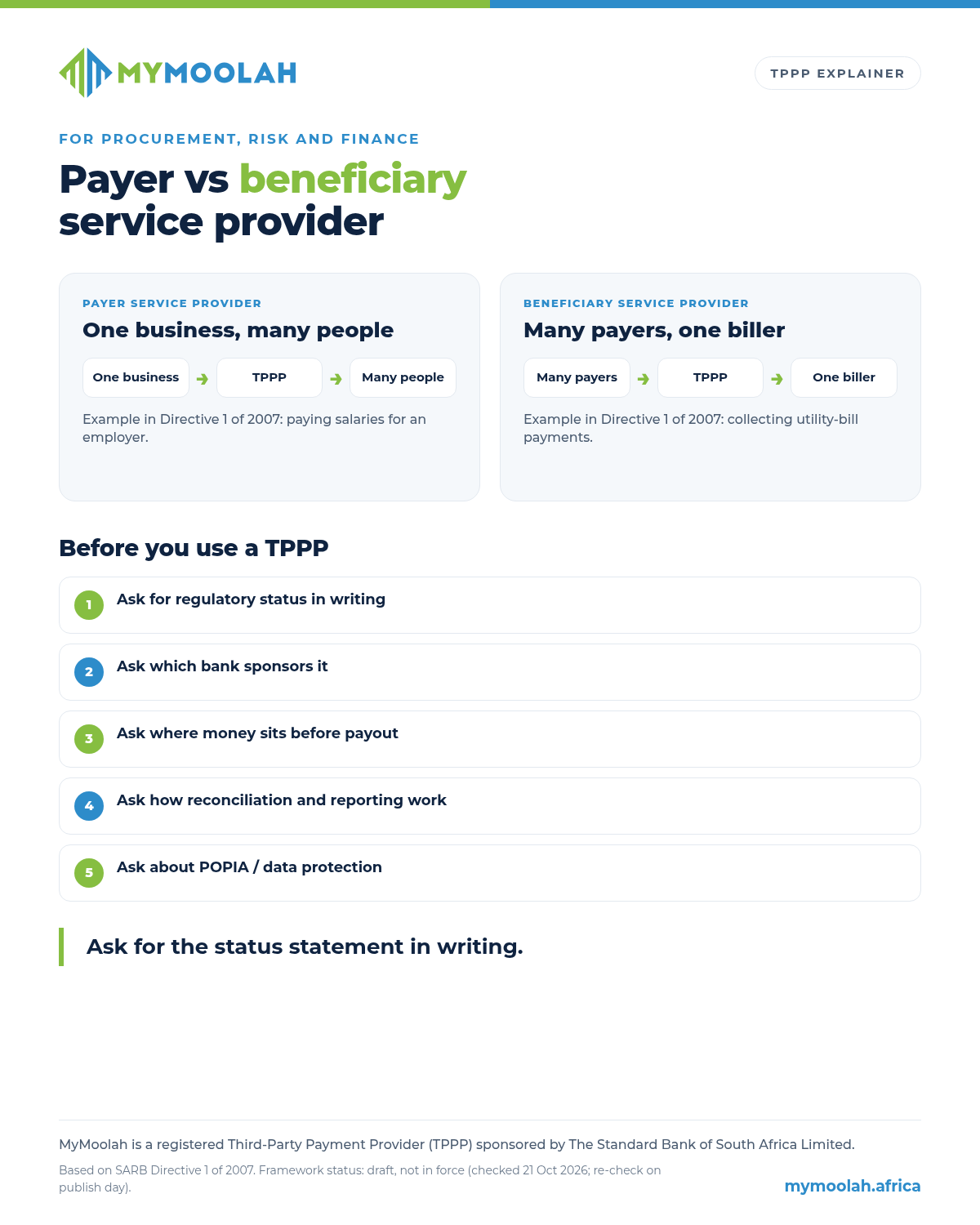
Directive 1 of 2007 uses two definitions and two everyday examples.
| Type | What it does | Directive example |
|---|---|---|
| Payer service provider | Accepts money from one payer to pay many beneficiaries on that payer’s behalf | Paying salaries for an employer |
| Beneficiary service provider | Accepts money from many payers on behalf of one beneficiary | Collecting utility-bill payments at a retailer or other outlet |
The same organisation can, in principle, act in either role for different clients. For a business that disburses wages, claims, commissions or rewards, you are usually buying a payer-service-provider pattern: one funded source, many recipients.
Who oversees TPPPs in South Africa?
The South African Reserve Bank (SARB) oversees the national payment system under the National Payment System Act. TPPP registration today sits with the SARB’s National Payment System Department. Existing registrations remain valid under the current arrangements until a new Authorisation Framework is published; the SARB publishes a public list of registered TPPPs on its website. Sources: SARB Regulation, Oversight and Supervision (TPPP Public Register for May 2026); SARB PSMB transition page (fetched 12 October 2026).
For history, TPPP registration previously ran through an industry-body registration process. That history matters for context; for a live vendor check, ask for the current status statement and sponsoring bank, and confirm the name on the SARB public register.
What is changing for TPPPs?
The SARB has published draft directives for an Authorisation Framework for specified payment activities. The current consultation text is the May 2026 draft (Directive X of 2026, marked “Draft for consultation”). Prudential Communication 10 of 2026 (published 20 May 2026) invited comment on a related draft Exemption Notice. Sources: Prudential Communication 10 of 2026; May 2026 draft Authorisation Framework (SARB National Payment System Department).
The draft is not in force and has no start date. It proposes an activity-based authorisation model for payment institutions, including third-party payment providers. It does not yet change how you must run payday tomorrow. Treat final Gazette text, when published, as the point at which obligations change, and re-check the SARB site on the day you rely on this article.
For a broader read on what changing payments rules mean for businesses that pay many people, see Who can move your payouts?
How do you check a TPPP before you use it?
- Ask for the regulatory status statement in writing. Prefer the exact wording the provider uses publicly, not a slogan.
- Ask which bank sponsors it. Under the current directive, TPPPs work through a sponsoring bank.
- Ask where your money sits before payout. Put the question to the provider and read the answer against your own risk policy. Do not rely on marketing adjectives about funds.
- Ask how reconciliation and proof of payment work. File upload or API, maker-checker, returned-payment handling and an audit trail per payee.
- Ask about data protection (POPIA). Who processes payee identity and contact details, and under which agreement.
Is MyMoolah a TPPP?
MyMoolah is a registered Third-Party Payment Provider (TPPP) sponsored by The Standard Bank of South Africa Limited. MyMoolah (Pty) Ltd appears on the SARB’s TPPP Public Register (May 2026 edition). It is not a bank.
For businesses that pay many people, MyMoolah supports payouts into MyMoolah digital wallets. You pre-fund a float with one EFT from your own bank account, then pay by portal upload or REST API. Pay into MyMoolah wallets free of charge. Each recipient’s wallet limits depend on their verification (KYC) level. Recipients open MyMoolah in their phone’s browser, complete identity checks, and can then send to other MyMoolah wallets, buy airtime, data and electricity, pay by QR at participating major retailers, send to a South African bank account, or cash out with a bank-issued cardless withdrawal PIN, where available. Fees apply to bank transfers and cash withdrawals.
Information current as at 21 October 2026. The Authorisation Framework is a draft and must be re-checked on the SARB website on publish day. This article is industry context, not legal advice.
Vetting a payout partner? Book a payout demo.
FAQ
What does TPPP stand for?
Third-party payment provider: a business that accepts money or payment instructions to pay a third party on someone else’s behalf, as a regular feature of its business.
Is a TPPP a bank?
No. A TPPP is a non-bank payment business. Under the current SARB directive it works through a sponsoring bank.
What is a payer service provider?
A TPPP that accepts money from one payer to pay many beneficiaries on that payer’s behalf. The directive’s example is paying salaries for an employer.
What is a beneficiary service provider?
A TPPP that accepts money from many payers on behalf of one beneficiary. The directive’s example is collecting utility-bill payments.
Is there a list of TPPPs in South Africa?
Yes. The SARB publishes a TPPP Public Register on its Regulation, Oversight and Supervision pages. Ask the provider for its regulatory status and sponsoring bank in writing, and confirm the name on that register.
Sources
- SARB Directive 1 of 2007 (payments to third persons; payer and beneficiary service provider definitions).
- Prudential Communication 10 of 2026 (20 May 2026) and the May 2026 draft Authorisation Framework (Draft for consultation).
- SARB Regulation, Oversight and Supervision (TPPP Public Register for May 2026).
- SARB PSMB transition page (TPPP registration with the SARB National Payment System Department; existing registrations remain valid until the Authorisation Framework is published). Checked 12 October 2026.