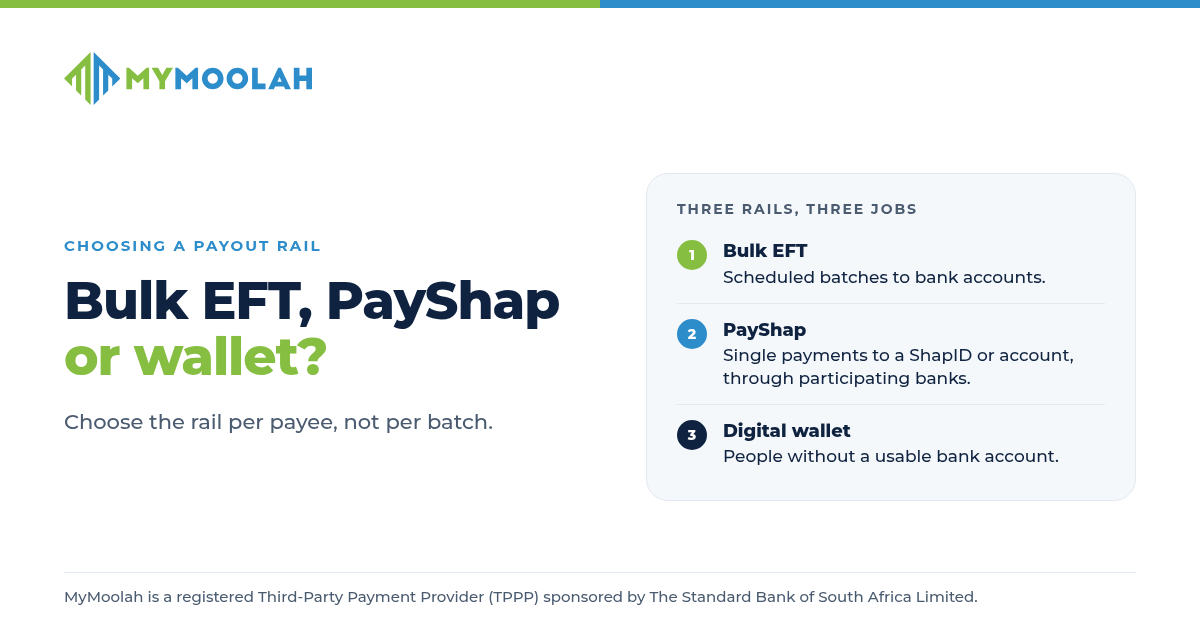

South African businesses pay out on three main rails. Bulk EFT suits scheduled batches to bank accounts. Real-time payments such as PayShap, available through participating banks, suit urgent single payments. Digital wallets suit people without a usable bank account. Many payout teams combine them, choosing the rail per payee rather than per batch.
TechCentral reported that, at a Reserve Bank media briefing on 16 October 2026, officials said PayShap handles about 60 million transactions a month, against a target of 500 million a month by 2029. Pradeep Maharaj, executive director of the Reserve Bank’s Payments Ecosystem Modernisation programme, said the banks had implemented PayShap differently and imposed clashing limits: “It is not a uniform experience, that is the problem.” Source: TechCentral, 16 October 2026. For payout teams, the same rail can behave differently from one bank to the next. This guide matches each rail to payroll, loans, claims, commission and rewards.
What payout rails can South African businesses use?
Most businesses use some mix of four: bulk EFT, real-time payments such as PayShap, digital wallets in the payee’s name, and cash-send vouchers. EFT still carries most of the value. In 2025, EFT credits made up 64.5% of retail payment settlement values in the Reserve Bank’s settlement system. Source: SARB, National Payment System Regulatory and Oversight Report 2025/26, published June 2026.
What is bulk EFT and when does it fit?
Bulk EFT sends many payments to bank accounts in one instruction. You upload a file in your bank’s format, with each payee’s name, account number, branch code, amount and reference, then approve the run. Banks process these files in set windows, so timing depends on when you submit, your bank’s cut-off times and the receiving bank.
Bulk EFT fits scheduled runs to bank accounts you have already verified, such as monthly payroll and routine commission. It works less well for a payment that can’t wait for the next batch, or for payees whose accounts are closed, dormant or in someone else’s name.
What is PayShap and can businesses use it for payouts?
PayShap is South Africa’s real-time payment rail, available through participating banks. A payment can go to a ShapID, such as a cellphone number, instead of an account number. The Reserve Bank reports 725 million successful PayShap transactions worth R659 billion since the 2023 launch, a record 60 million transactions in December 2025, and 14 participating banks. Those figures include real-time clearing transactions migrated onto PayShap. Source: SARB, NPS Regulatory and Oversight Report 2025/26, section 4.4.
Limits vary by bank. The system ceiling was raised from R3,000 to R50,000 per transaction in November 2024, but each bank decides when to offer the higher limit to its customers and how to price it. Source: TechCentral, 6 November 2024. At the October briefing, as reported by TechCentral, the Reserve Bank said transactions below a certain level should be free, and that a standardised QR+ payment code is expected in November 2026. Source: TechCentral, 16 October 2026. Until any such changes take effect, plan on your bank’s current limits and fees.
For payouts, PayShap fits single payments that can’t wait for a batch, such as an approved loan, an urgent claim or a payroll correction. Before you build on it, ask your bank for your per-payment and daily limits, whether it offers batch or API sending, the cost per payment, and how it reports failed payments.
Where do digital wallets fit?
A digital wallet is opened in the payee’s own name after identity checks (KYC). It suits people without a usable bank account, and frequent small payments such as weekly commission, incentives and rewards. The payee can keep a balance and spend or move it from their phone. Wallet limits follow each payee’s verification level, so check them against your largest payouts. If you pay wages into wallets, read our guide on how to pay casual workers first.
What about cash-send vouchers?
A cash-send voucher sends a PIN or code to the payee’s phone, which they redeem for cash at a participating ATM or till. It suits a one-off payment to someone who needs cash in hand. The provider sets the fees, expiry and limits, and the payee has no balance to keep afterwards. Keep proof of each send.
Which rail for which payout?
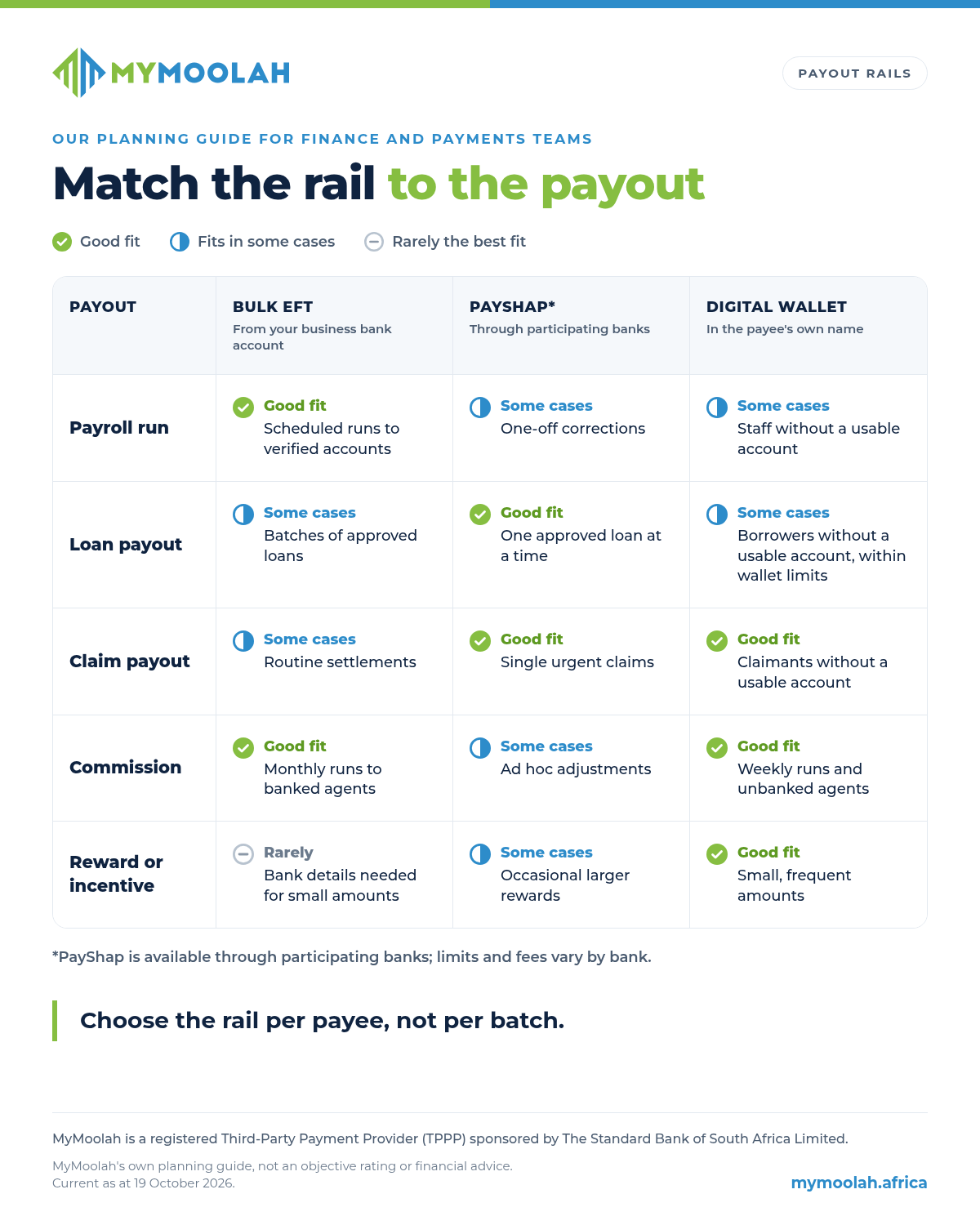
Choose per payee, not per batch. Treat this table as a planning guide.
| Payout | Usual first choice | Also consider |
|---|---|---|
| Payroll run | Bulk EFT, on a fixed schedule | Wallets for staff without a usable account |
| Loan payout | PayShap through your bank | Wallets for borrowers without a usable account, within wallet limits |
| Claim payout | PayShap for urgent claims, bulk EFT for routine ones | Wallets for claimants without a usable account |
| Commission | Bulk EFT for monthly runs | Wallets for weekly runs and unbanked agents |
| Reward or incentive | Wallets | PayShap for occasional larger rewards |
Whatever the mix, compare the total cost per successful payment, including the rework on returned payments.
How MyMoolah fits with your other rails
MyMoolah is a registered Third-Party Payment Provider (TPPP) sponsored by The Standard Bank of South Africa Limited. It is not a bank.
MyMoolah adds the wallet rail to the bank rails you already use. You pre-fund a MyMoolah float with one EFT from your own bank account, then pay into MyMoolah wallets by portal upload or REST API. Pay into MyMoolah wallets instantly and free of charge, from your funded float, within each recipient’s verification (KYC) limits. Payees open MyMoolah in their phone’s browser, so there is no app to download.
Once paid, payees can send money to other MyMoolah wallets, buy airtime, data and electricity, pay by QR at participating major retailers, send to a South African bank account, or cash out with a bank-issued cardless withdrawal PIN, where available. Free between MyMoolah wallets, up to R100,000, within your verification (KYC) limits. Fees apply to bank transfers and cash withdrawals.
Information current as at 19 October 2026. This article is industry context, not legal or financial advice. Check limits and fees with your bank and provider before you change a payout process.
Paying people on more than one rail? Book a payout demo.
FAQ
What is the PayShap limit?
The system ceiling was raised from R3,000 to R50,000 per transaction in November 2024, but each participating bank sets its own customer limits and pricing, so check with your bank.
Can businesses use PayShap for bulk payments?
It depends on your bank. Batch and API options, limits and pricing vary by bank, so ask before you plan a payout run around it.
Is bulk EFT the same as a real-time payment?
No. Bulk EFT sends many payments together and is processed in bank processing windows. A real-time payment such as PayShap is sent and cleared one payment at a time.
How do you pay someone who has no bank account?
Pay into a digital wallet opened in their own name, or use a cash-send voucher they collect with a PIN.
How do payout rail costs compare?
Costs depend on the rail, your bank or provider, and the volume you send. Compare the total cost per successful payment, including failed-payment handling.
Sources
- TechCentral, “South Africa’s ATM network faces its biggest overhaul in decades”, Fanie van Rooyen, 16 October 2026 (Reserve Bank media briefing: PayShap volumes and target, clashing limits, QR+ timing).
- South African Reserve Bank, National Payment System Regulatory and Oversight Report 2025/26 (period 1 April 2025 to 31 March 2026; retail settlement values, p. 25; PayShap statistics, section 4.4).
- TechCentral, “PayShap payment limit raised to R50 000”, Nkosinathi Ndlovu, 6 November 2024.
- South African Reserve Bank, QR+ Standard 1.2, published 7 July 2026.