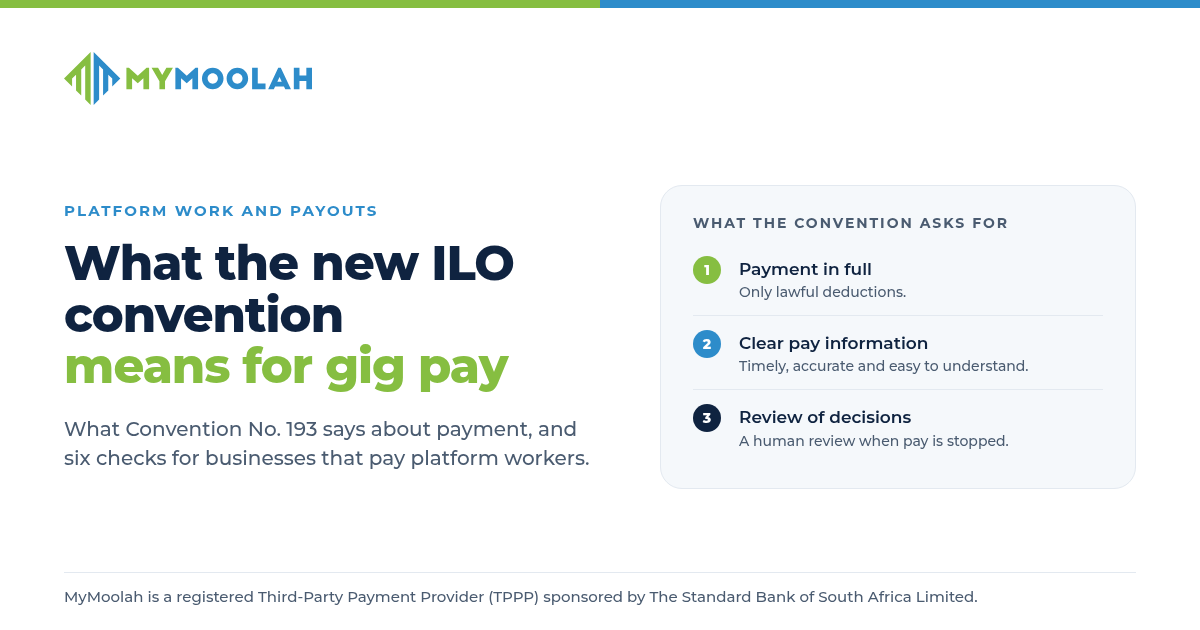

The ILO’s new Convention No. 193 asks countries that ratify it to ensure platform workers are paid what they are owed in full, with only lawful deductions, and get clear information on pay and deductions. It is not South African law, but the Department of Employment and Labour is using it as a reference framework for regulating platform work.
This article is for platforms, fleet owners and labour intermediaries that pay e-hailing drivers, delivery riders, couriers, domestic workers and other on-demand workers. It covers Thursday’s seminar, what the Convention says about payment, and six checks for how you pay people now.
What is happening on 19 November?
On Thursday, 19 November 2026, the Department of Employment and Labour hosts a seminar in Pretoria on platform work. According to the Department’s media advisory of 16 November, the seminar will introduce Convention No. 193 “as a reference framework for strengthening the regulation of platform work in South Africa”. It will also share findings from a Department-commissioned study by the Development Policy Research Unit at the University of Cape Town, which surveyed e-hailing drivers and platform-based domestic workers.
The seminar follows a briefing to Parliament’s Portfolio Committee on Employment and Labour on 26 August 2026. As summarised by Legal 500, the options under consideration include clearer guidelines on worker classification, a possible sector-specific minimum earnings standard, more transparency about algorithmic decisions, and extending occupational health and safety, UIF and Compensation Fund cover to platform workers. The same summary notes that the briefing “does not itself alter the legal position applicable to platform workers”.
Terms used in this article
- Digital labour platform: a business that uses automated systems, such as apps and algorithms, to organise work done by people for payment, online or in a specific place.
- Platform worker: anyone who does work through a digital labour platform for payment, whether they are an employee or self-employed.
- Intermediary: a business between the platform and the worker, such as a fleet owner or labour contractor.
- Deduction: any amount taken off what a worker is owed, such as equipment rental, insurance or a penalty.
What does Convention No. 193 say about pay?
The International Labour Conference adopted the Decent Work in the Platform Economy Convention, 2026 (No. 193) in June 2026. The ILO’s own overview for its Governing Body (13 October 2026) says it applies to all digital platform workers, “those who are employees and those who are not, such as the self-employed”, and that intermediaries are also covered. On payment, the main points of the Convention’s official text (Articles 9, 10, 11 and 15) are:
| Area | What the Convention provides | Who it covers |
|---|---|---|
| Payment in full | What is due is paid on time and in full, subject only to lawful deductions | All platform workers |
| Pay information | Timely, accurate and easily understandable information on pay and on any deductions | All platform workers |
| Minimum pay | Minimum remuneration for workers in an employment relationship; countries must consider whether to extend it to others | Employees, with others to be considered |
| Automated decisions | A right to ask for a written explanation, and a review with human involvement of decisions that lead to non-payment, suspension, deactivation or termination | All platform workers |
| Classification | Status guided mainly by the facts of how the work is done and paid, not just the label in the contract | All platform workers |
A convention binds a country only once that country ratifies it and gives effect to it in its own law. Until then, South African labour law applies as it stands.
Why is payment at the centre of the debate?
Platform pay is often per task, with costs and deductions taken before the worker sees the money. A study by Danmore Chuma for the International Labour Research and Information Group (ILRIG), based on interviews with 60 motorcycle delivery riders in Cape Town and Johannesburg, found that riders were paid per delivery with no pay for waiting time. Riders also described weekly deductions for safety gear and for accident cover that some said they never benefited from. It is a small study, not a national figure, but it shows why the Convention pairs payment in full with clear information on deductions.
What should businesses that pay platform workers check now?
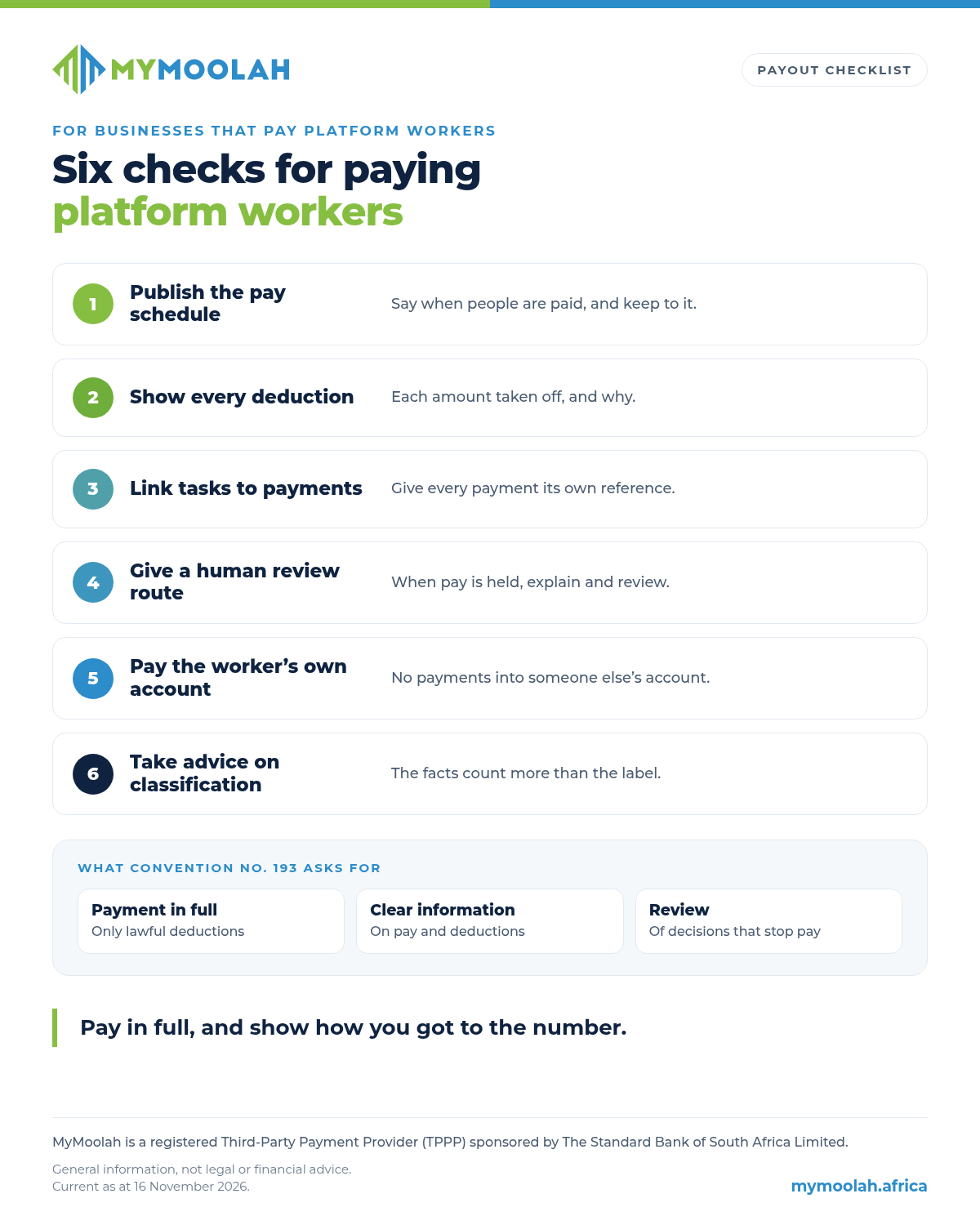
- Publish the pay schedule and keep to it. Tell workers when they are paid, daily or weekly, and what happens on weekends and public holidays.
- Show every deduction. Give each worker a statement that sets out what each task paid, every amount taken off and why, and the total paid out.
- Link every task to a payment. Give every payment its own reference so that a worker’s query can be traced from the task to the money. Our guide to reconciling bulk payouts sets out a routine.
- Give a human review route. When a payment is held or an account is suspended, tell the worker why and how to ask a person to review it.
- Pay into an account in the worker’s own name. Avoid paying into someone else’s account on a worker’s behalf. Where a fleet owner or contractor sits in between, be clear who pays whom. Our payout fraud controls cover changes to payment details.
- Take advice on classification. Under the Convention, the facts of how work is done count more than the contract label. Get legal advice on how your workers should be classified before rules change, not after.
Many of these points overlap with how businesses already pay casual and temporary workers and sales agents on commission.
How do wallet payouts fit?
MyMoolah is a registered Third-Party Payment Provider (TPPP) sponsored by The Standard Bank of South Africa Limited. Businesses pre-fund a MyMoolah float with one EFT from their own bank account, then pay people into MyMoolah wallets by portal upload or REST API. Each run is prepared by one person and approved by another before it is released.
Pay into MyMoolah wallets instantly and free of charge, from your funded float, within each recipient’s verification (KYC) limits.
Wallet payouts can go out on weekends and public holidays, which suits daily and weekly pay, and every business can download its float statement. You don’t need workers’ bank account details. Each wallet is in the worker’s own name. Until identity checks are complete, a wallet can only receive money, and limits depend on each payee’s verification (KYC) level. Once verified, workers can send money to other MyMoolah wallets, buy airtime, data and electricity, pay by QR at participating major retailers, send to a South African bank account, or cash out with a bank-issued cardless withdrawal PIN, where available. Free between MyMoolah wallets, up to R100,000, within your verification (KYC) limits. Fees apply to bank transfers and cash withdrawals.
Wallet payouts don’t settle the questions above. Pay rates, deductions, statements and classification stay with your business.
Your business can also earn a share of the revenue from the wallets it pays into, under agreed commercial terms.
Information current as at 16 November 2026. This article is general information, not legal or financial advice. Confirm current product terms and wallet limits before you integrate.
Paying drivers, riders or other on-demand workers? Book a payout demo.
FAQ
What is ILO Convention No. 193?
It is the Decent Work in the Platform Economy Convention, 2026, adopted by the International Labour Conference in June 2026. It is the first international labour standard written specifically for work done through digital labour platforms.
Does Convention No. 193 apply in South Africa now?
Not on its own. A convention binds a country only once it is ratified and given effect in national law. The Department of Employment and Labour is using it as a reference framework while it considers how to regulate platform work.
Does the Convention set a minimum wage for gig workers?
It provides for minimum remuneration for platform workers who are in an employment relationship. For those who are not, it asks countries to consider whether such measures should apply.
What must platforms tell workers about their pay?
Under the Convention, platform workers should get timely, accurate and easily understandable information about their pay and any deductions made from it.
Can platform workers be paid into a wallet instead of a bank account?
Yes. A business can pay workers into a MyMoolah wallet in the worker’s own name, without their bank account details. Where the worker is an employee, they can choose to be paid into a MyMoolah wallet in their own name, designated in writing. Limits depend on each payee’s verification (KYC) level.
Sources
- Department of Employment and Labour, media advisory: seminar on South Africa’s labour market, 19 November (16 November 2026; accessed 16 November 2026).
- International Labour Conference, Decent Work in the Platform Economy Convention, 2026 (No. 193), text adopted 12 June 2026 (accessed 16 November 2026).
- International Labour Office, GB.358/INS/4/2: Follow-up to the resolution on the standard-setting item on decent work in the platform economy (13 October 2026; accessed 16 November 2026).
- Jeffrey Vogt, “ILO Convention 193 on Decent Work in the Platform Economy”, Global Workplace Law & Policy (Wolters Kluwer) (12 August 2026; commentary on Articles 10 and 11; accessed 16 November 2026).
- Henry Rossouw and Lara Keil, “Platform Work Moves Up South Africa’s Labour Law Reform Agenda”, Legal 500 (7 September 2026; accessed 16 November 2026).
- Danmore Chuma, “No protection, high risk: the harsh realities faced by SA’s e-riders”, ILRIG (10 November 2026; accessed 16 November 2026).