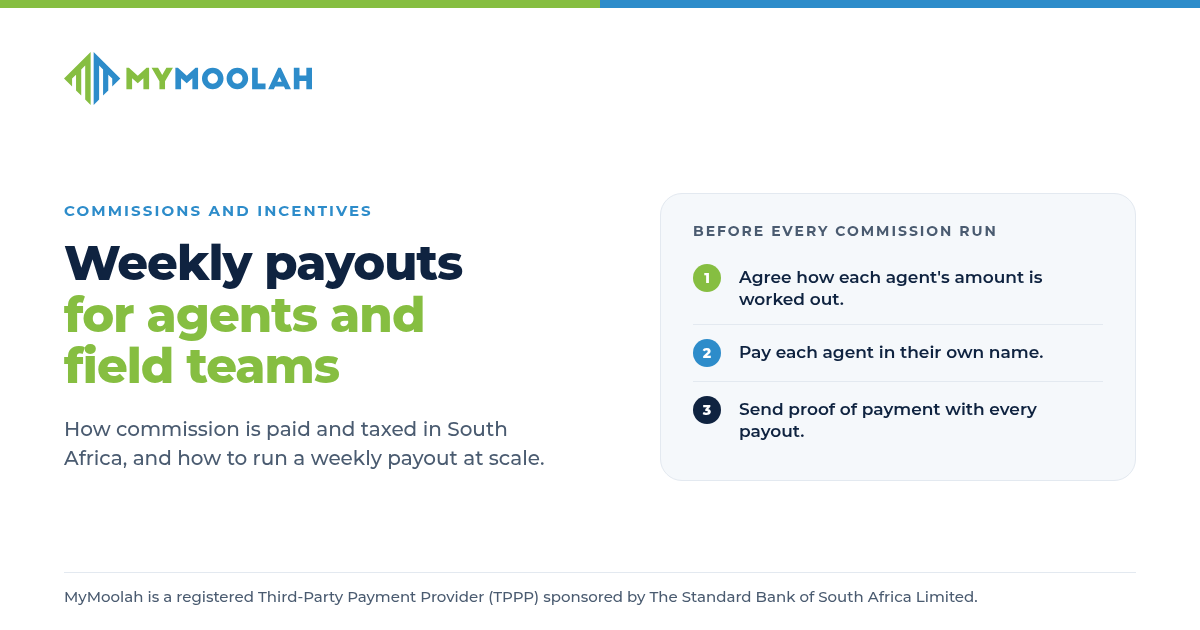

In South Africa, commission paid to an employee is remuneration, so the employer deducts employees’ tax (PAYE), following a SARS tax directive where the employee has one. Independent agents are usually paid under their agreement and deal with their own tax. Either way, every agent has to be paid the right amount on time, often weekly.
This guide is for sales-ops, channel and field-force managers, and for teams that run incentive and reward programmes for promoters and brand ambassadors. It covers how agents get paid, what SARS’s employer guide says about commission, why payout runs go wrong, and a six-step weekly commission run.
How do sales agents get paid in South Africa?
Most sales teams use one of three models:
- Salary plus commission. The agent is an employee, and commission runs through payroll with the salary.
- Commission only, as an employee. The agent is on payroll but paid mainly or wholly on results.
- Independent agents. Paid under a commercial agreement, often against a statement or invoice, and not on your payroll.
Which group a person falls into depends on the contract and on how the work is done in practice. SARS’s employer guide says the analysis starts with the contract, and refers employers to its Interpretation Note 17 for guidelines. If you are unsure, get advice before you set up the payout. If your agents are employees, wage rules apply as well; our guide on how to pay casual and temporary workers covers how wages may be paid.
How is commission taxed?
For employees, SARS’s Guide for Employers in respect of Employees’ Tax (2027 tax year) sets out the rules in its section on commission agents:
- If the employee has a tax directive, the employer must deduct employees’ tax according to the directive.
- If an employee earns salary and commission and has no directive, the employer must combine the two and deduct tax using the tax deduction tables. The guide says that no flat 25%, or any other percentage, may be deducted unless a directive says so.
- An employee may apply for a directive only where their remuneration consists mainly of commission based on their own sales or turnover.
For independent contractors, the guide says their income is excluded from the definition of remuneration, so no employees’ tax is deducted, unless one of its exceptions applies. Those exceptions turn on where the work is done and who controls how it is done. Source: SARS, PAYE-GEN-01-G21, Guide for Employers in respect of Employees’ Tax (2027 tax year), “Independent contractor” (p. 26) and “Commission agents” (p. 29).
This is a summary of SARS’s guidance, not tax advice. Confirm your own position with a registered tax practitioner.
How often should commission be paid?
For agents paid by agreement, there is no single rule. The agreement sets how often commission is paid and the cut-off for counting sales. For employees, pay frequency is a payroll question.
Weekly runs are worth considering when agents rely on each week’s earnings, when you want an incentive to land close to the effort that earned it, or when disputes are easier to settle while the week is fresh. The trade-off is more runs to approve, fund and reconcile, which is why the run itself has to be simple.
Why do commission and incentive payouts go wrong?
When a commission run slips, the cause is usually practical:
- Commission is calculated in a spreadsheet that someone rebuilds every week.
- Approval is left to the last day, so the run is late.
- Agents can’t see how their figure was worked out, so they dispute it.
- An agent has no usable bank account and gives a relative’s account instead, which makes it harder to prove who was paid.
- There is no proof of payment per agent, so queries take days to answer.
Account access is part of the picture. World Bank Global Findex data put account ownership among South African adults at 81.1% in 2024. By our arithmetic, that leaves about one adult in five without an account, and some people with an account no longer use it. Source: World Bank, Global Findex 2025 (indicator FX.OWN.TOTL.ZS, South Africa, 2024).
Cash, airtime or money: what works for incentives?
Airtime and data rewards are easy to send and easy to understand, but they are locked to one use. Money paid into a wallet lets the person choose: airtime or data if that is what they need, electricity, a QR payment at a participating major retailer, or cash.
Whatever form an incentive takes, the tax question still applies. SARS’s employer guide lists an incentive bonus paid to an employee as an example of an annual payment, which is subject to employees’ tax (“Annual payments/bonus”, p. 33). For people who are not your employees, the treatment depends on the arrangement, so ask your tax practitioner.
What does a weekly commission run look like?
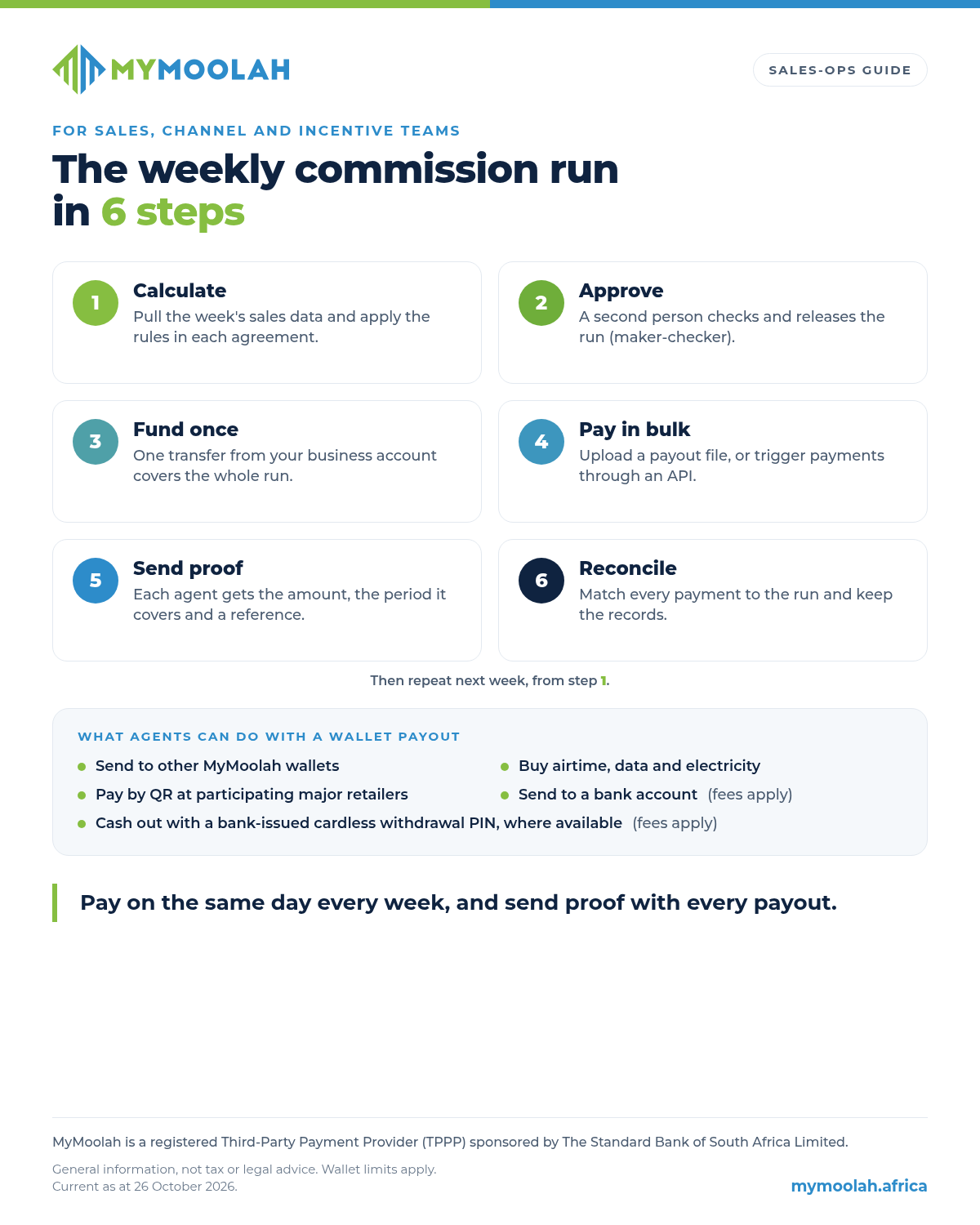
- Calculate. Pull the week’s sales data and apply the commission rules in each agreement.
- Approve. A second person checks and releases the run (maker-checker).
- Fund once. One transfer from your business account covers the whole run.
- Pay in bulk. Upload a payout file, or trigger payments through an API from your sales system.
- Send proof. Each agent gets the amount, the period it covers and a reference.
- Reconcile. Match every payment to the run and keep the records.
Record each agent’s chosen payout destination in writing, in their own name. For more on choosing how the money moves, see bulk EFT vs PayShap vs wallet payouts and what a disbursement platform is.
How does MyMoolah pay agents and incentive winners?
MyMoolah is a registered Third-Party Payment Provider (TPPP) sponsored by The Standard Bank of South Africa Limited. You pre-fund a MyMoolah float with one EFT from your business bank account, then pay agents into their MyMoolah wallets by portal upload or REST API, as one weekly batch or as payments triggered by your own system.
Pay into MyMoolah wallets instantly and free of charge, from your funded float, within each recipient’s verification (KYC) limits.
Agents open MyMoolah in their phone’s browser, so there is no app to download. Each wallet is in the agent’s own name. Until identity checks are complete, a wallet is receive only, capped at R5,000, so ask agents to verify before their first run. Once verified, they can send money to other MyMoolah wallets, buy airtime, data and electricity, pay by QR at participating major retailers, send to a South African bank account, or cash out with a bank-issued cardless withdrawal PIN, where available. Free between MyMoolah wallets, up to R100,000, within your verification (KYC) limits. Fees apply to bank transfers and cash withdrawals.
If your agents are employees, paying into a wallet doesn’t change your PAYE, UIF or payslip duties.
Information current as at 26 October 2026. This article is general information, not tax, legal or employment advice. Confirm current product terms and wallet limits before you integrate.
Running weekly commission or incentive payouts? Book a payout demo.
FAQ
Is commission taxable in South Africa?
Yes. For employees, commission forms part of remuneration, and the employer deducts employees’ tax under SARS’s rules, following a tax directive where the employee has one. Independent contractors usually account for their own tax. Check with your tax practitioner.
Is commission paid monthly?
Not necessarily. For agents paid by agreement, the agreement sets how often commission is paid. Some teams pay weekly, others monthly.
Can I pay commission into a digital wallet?
Yes, if the agent chooses it; record that choice in writing. With MyMoolah, the wallet is in the agent’s own name, and limits depend on the agent’s verification (KYC) level. Until identity checks are complete, a wallet is receive only, capped at R5,000. Verified wallets have these limits: Tier 1, R5,000 per transaction; Tier 2, R25,000 per transaction and R100,000 a month.
Are incentives and rewards taxable?
They can be. SARS’s employer guide lists an incentive bonus paid to an employee as an annual payment, which is subject to employees’ tax. For people who are not your employees, the treatment depends on the arrangement. Ask your tax practitioner.
Can agents use their payout for airtime and electricity?
Yes. Verified MyMoolah wallet holders can buy airtime, data and electricity, pay by QR at participating major retailers, or send money to a South African bank account (fees apply).
Sources
- SARS, PAYE-GEN-01-G21, Guide for Employers in respect of Employees’ Tax (2027 tax year), Revision 1 (“Independent contractor”, p. 26; “Commission agents”, p. 29; “Annual payments/bonus”, p. 33; accessed 26 October 2026).
- World Bank, Global Findex 2025: account ownership, South Africa, 2024 (accessed 26 October 2026).