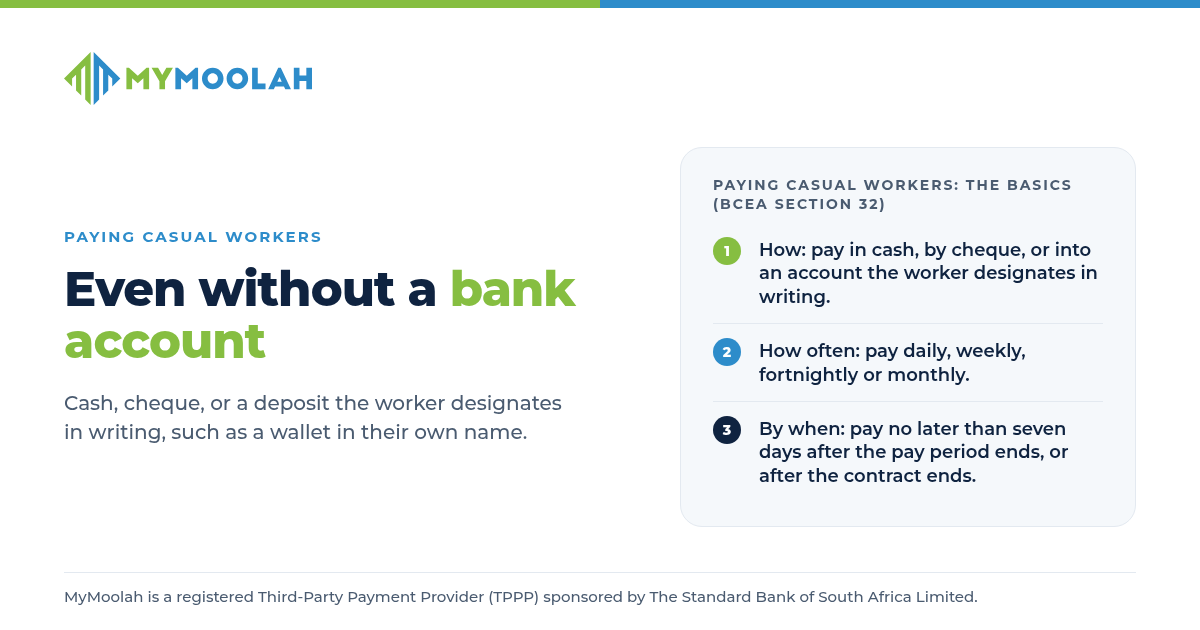

In South Africa, the Basic Conditions of Employment Act lets employers pay wages by direct deposit into an account the employee designates in writing, or in cash or by cheque, daily, weekly, fortnightly or monthly, within seven days of the pay period ending. For workers without a bank account, a digital wallet in their own name, designated in writing, is one workable alternative to the cash envelope.
If you run a temporary employment service, a security or cleaning firm, an events crew or an agri team, some of your people will not have a usable bank account in their own name. This guide sets out what the Act says about how and when you pay, why cash payday is hard to run at scale, and four options for paying workers who are not banked, including a MyMoolah wallet opened in the worker’s own name.
What does the law say about how you pay casual workers?
Cash, cheque or direct deposit: the three options in BCEA section 32
Section 32 of the Basic Conditions of Employment Act (BCEA) says an employer must pay remuneration that is paid in money in South African currency; daily, weekly, fortnightly or monthly; and in cash, by cheque, or by direct deposit into an account designated by the employee in writing. Source: Basic Conditions of Employment Act 75 of 1997, section 32.
The BCEA lets employers pay wages by direct deposit into an account the employee designates in writing. If a worker chooses to be paid into a MyMoolah wallet in their own name, get that choice in writing. Payslip details under section 33, and your UIF and PAYE duties, still apply. This is not a claim that a wallet is “BCEA-compliant” or “approved”; it is how the Act describes payment methods, and how a written designation can work in practice.
When must casual and temporary workers be paid?
The same section allows daily, weekly, fortnightly or monthly pay. Remuneration must be paid no later than seven days after the pay period ends, or after the contract ends. Check any sectoral determination or bargaining-council agreement that applies to your sector; those can set tighter rules than the Act’s baseline.
If you pay cash, what are the rules?
Cash or cheque payments must be handed over at the workplace or a place the employee agrees to, during working hours or within 15 minutes of them starting or ending, in a sealed envelope that becomes the employee’s property. Those rules are specific to cash and cheque. They do not themselves solve the operational cost of moving cash every week.
Do casual workers pay tax and UIF?
How you pay does not remove tax and UIF duties. If the person is an employee for tax purposes, follow SARS’s employer guidance on employees’ tax and UIF registration, and get advice from your payroll practitioner. Signpost: SARS Guide for Employers in respect of Employees’ Tax (2027 tax year). Independent contractors and commission agents are usually not employees under the BCEA; pay them under your commercial agreement, not under a casual-employee framing.
Why is cash payday a problem for employers?
Cash still works for many teams. At volume it creates its own problems: you have to draw and move cash, keep it safe on site, queue people for envelopes, reconcile what was handed over, and rebuild the trail when a dispute arises. Robbery and lost envelopes are real operational risks. None of that proves cash is unlawful (the Act allows it), but it explains why many employers look for a payment method that leaves a record in the worker’s own name.
How do you pay workers who don’t have a bank account?
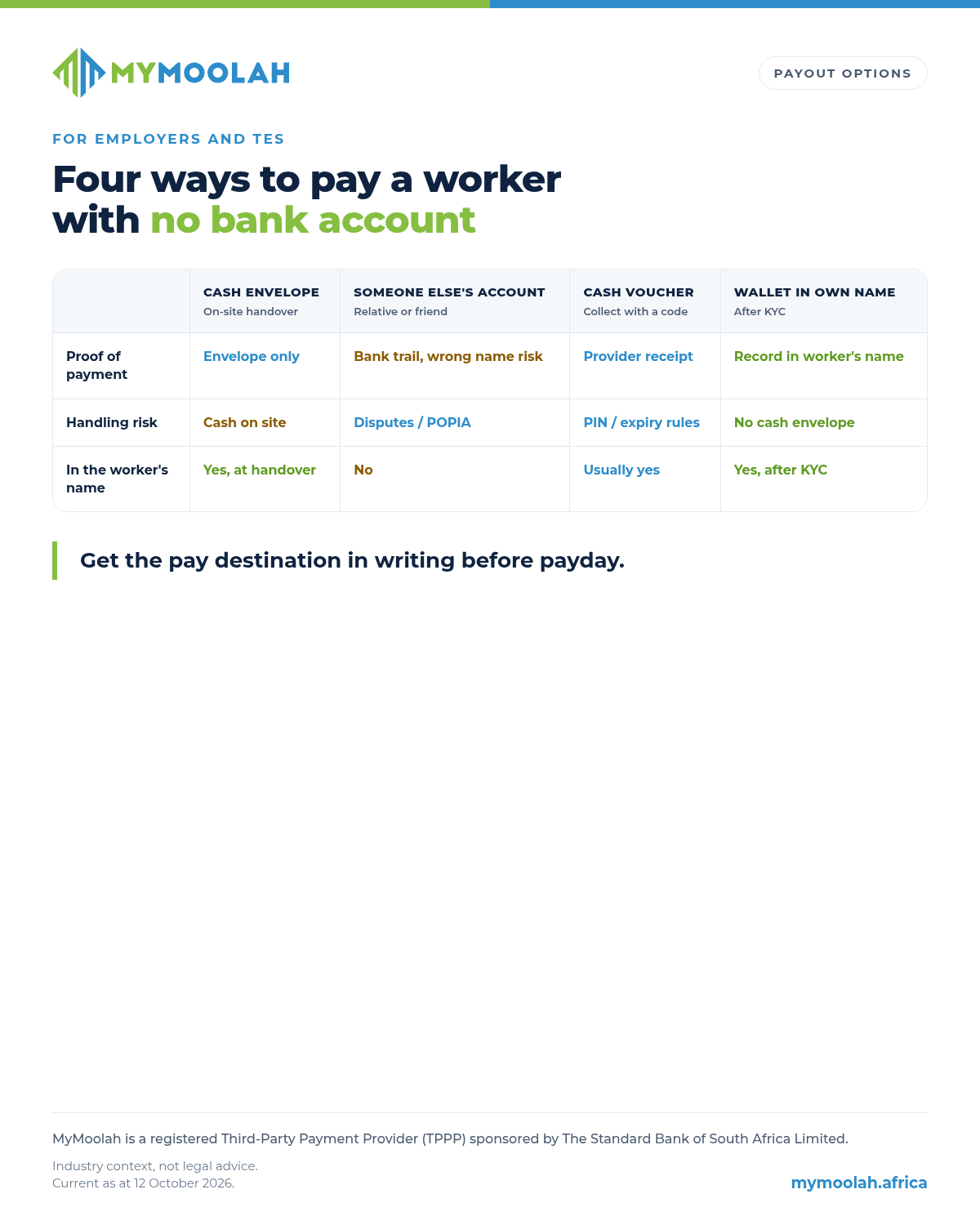
Option 1: cash envelopes
Lawful when you follow section 32(2). Best for very small teams where you can supervise handovers. Weak on audit trail and high on handling risk once headcount grows.
Option 2: pay into someone else’s account
Common when a relative or friend holds the only usable account. The risks are disputes about who was paid, money going to the wrong person, and POPIA consent questions about processing someone else’s banking details. You still need proof that the named worker was paid. Section 32 refers to an account the employee designates in writing, so get the worker’s written designation, and take advice before paying into another person’s account.
Option 3: send-to-cellphone cash vouchers
A voucher the worker collects with a PIN or code can reach people without bank accounts. Treat it as a one-off cash-collection rail: confirm the provider’s rules, fees and expiry, and keep proof of each send. A voucher is not one of the three payment methods named in section 32, so take advice before using vouchers for wages.
Option 4: a digital wallet opened in the worker’s own name
The worker opens a wallet in their own name after identity checks (KYC), and designates that wallet in writing as where wages should be paid. You get a payment record against the person you employed. The worker can then use the money from their phone without you handling cash on site.
What should a weekly pay run look like?
- Collect payee details and consent. Capture each worker’s preferred destination and get a written designation where you pay into an account or wallet they choose.
- Verify identity. Know who you are paying. Match the person on the roster to the destination you will credit.
- Fund once. Move the pay-run total from your business bank account into one funded float, rather than many separate draws.
- Pay in bulk. Upload a file or call an API so the whole run goes out under maker-checker controls.
- Reconcile and keep proof of payment. Keep a trail per worker for payroll queries, UIF/PAYE records and disputes. Section 33 still requires written pay information on each payday.
How MyMoolah fits
MyMoolah is a registered Third-Party Payment Provider (TPPP) sponsored by The Standard Bank of South Africa Limited. It is not a bank.
For employers that pay many people, you pre-fund a MyMoolah float with one EFT from your own bank account, then pay into MyMoolah wallets by portal upload or REST API. Pay into MyMoolah wallets free of charge. Each worker’s wallet limits depend on their verification (KYC) level. Workers open MyMoolah in their phone’s browser. There is no app to download. They complete identity checks so the wallet is in their own name.
Once paid, workers can send money to other MyMoolah wallets, buy airtime, data and electricity, pay by QR at participating shops, send to a South African bank account, or cash out through approved partner channels, where available. Free between MyMoolah wallets, up to R100,000, within your verification (KYC) limits. Fees apply to bank transfers and cash withdrawals.
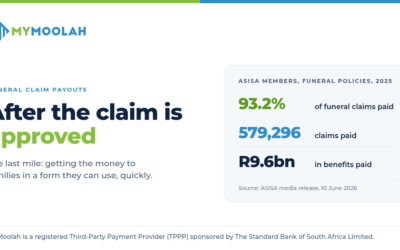
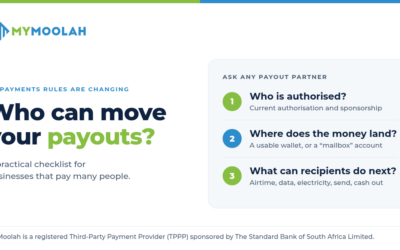
For a wider view of who may move payouts in South Africa, see Who can move your payouts? For another last-mile payout pattern, see funeral claim payouts.
Information current as at 12 October 2026. This article is industry context, not legal or tax advice. Confirm current product terms, KYC limits and any sectoral determination before you change a pay process.
Pay casual or temporary workers? Book a payout demo.
FAQ
Yes. The BCEA allows cash, but it must be handed over at the workplace (or a place the employee agrees to), during working hours or within 15 minutes of them, in a sealed envelope that becomes the employee’s property.
The BCEA allows daily, weekly, fortnightly or monthly pay, and remuneration must be paid no later than seven days after the pay period ends. Check any sectoral determination or bargaining-council agreement that applies to your sector.
The BCEA allows cash, cheque, or direct deposit into an account the worker designates in writing. For workers without a bank account, that can be a digital wallet opened in their own name. A wallet gives each worker a payment record in their own name and saves you from handling cash.
Yes. How you pay does not change your tax and UIF obligations. Follow SARS’s employer guidance and get advice from your payroll practitioner.
No download is needed. MyMoolah is a web app that opens in the phone’s browser.
Sources
- BCEA section 32, Payment of remuneration (Basic Conditions of Employment Act 75 of 1997).
- BCEA section 33, Information about remuneration (same Act; payslip particulars on each payday).
- SARS, Guide for Employers in respect of Employees’ Tax (2027 tax year), PAYE-GEN-01-G21.
- SARB Directive 1 of 2007 (payer service provider example: payment of salaries on behalf of employers).