
Loan disbursement is the step where a lender pays an approved loan to the borrower. In South Africa it usually happens by EFT to the borrower’s bank account once the credit agreement is signed and checks are complete. Lenders who serve people without a usable bank account can disburse into a digital wallet in the borrower’s own name.
This guide is for operations, credit and product teams at registered credit providers and microlenders. It covers the steps between approval and payout, why loan payouts fail, what the latest National Credit Regulator figures show about short-term credit, and a six-point checklist.
What does loan disbursement mean?
Disbursement is the payout: the point at which approved credit becomes money the borrower can use. It is also where your credit process meets your payments process, so a mistake in either shows up here, often as a returned payment.
People also search for “disbursement fee”. Disbursement is the act of paying out the loan, not a charge. The National Credit Act sets out the only amounts a credit agreement may require the consumer to pay: the principal debt, an initiation fee and a service fee within prescribed caps, interest up to the prescribed maximum rate, the cost of permitted credit insurance and, after a default, capped default administration charges and collection costs. A separate disbursement or payout fee is not on that list, so check fee questions with your compliance officer. Source: National Credit Act 34 of 2005, section 101.
What happens between approval and payout?
Under the National Credit Act, a credit provider must not enter into a credit agreement without first taking reasonable steps to assess the borrower’s understanding of the risks and costs of the credit, their debt repayment history, and their existing financial means, prospects and obligations, and must not enter into a reckless credit agreement (section 81). Before the agreement is made, the credit provider must also give the consumer a pre-agreement statement and quotation in the prescribed form (section 92). Disbursement follows those steps. This is general information, not legal advice; your own compliance team remains responsible for how you meet the Act.
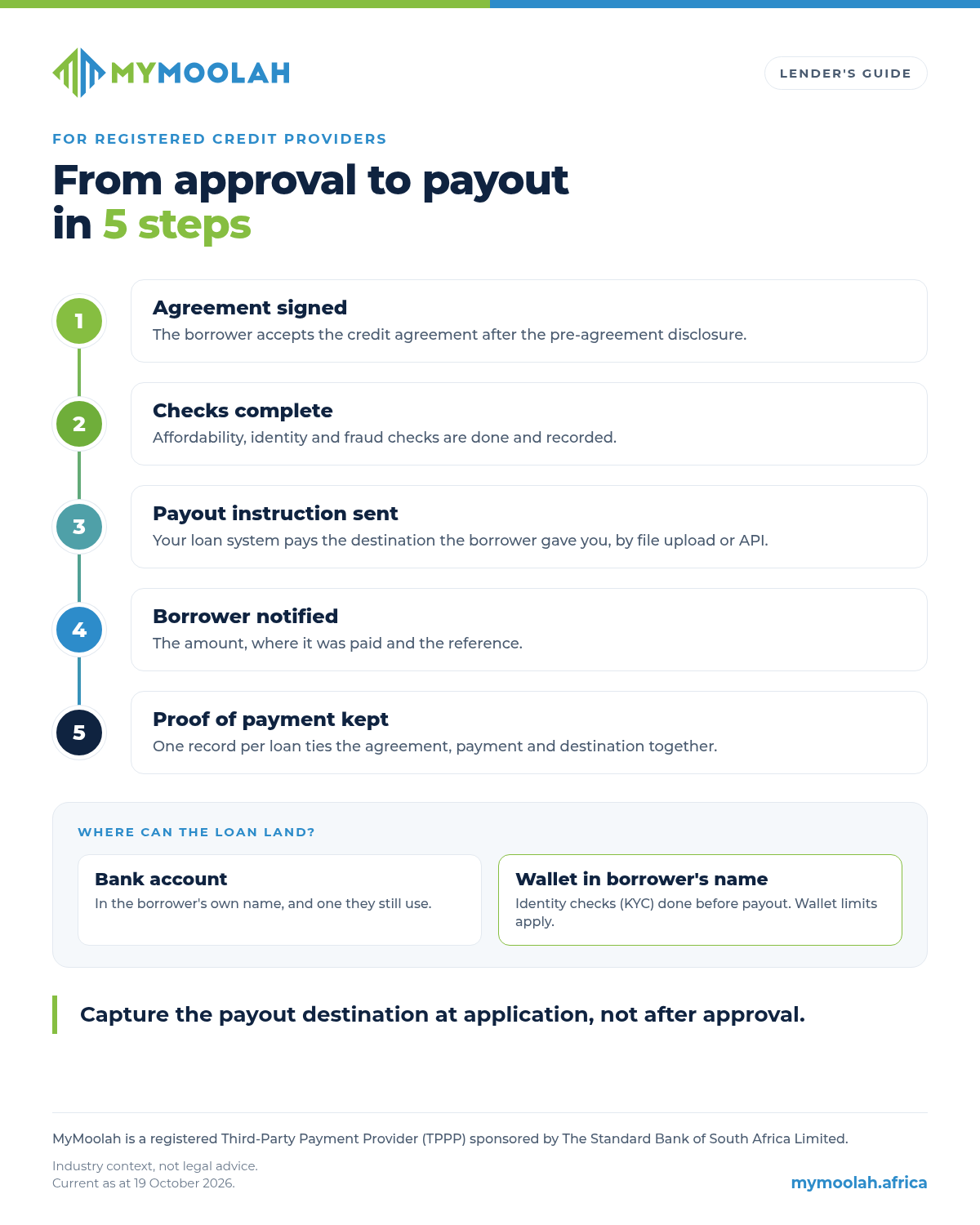
In practice, the sequence is:
- Agreement signed. The borrower accepts the credit agreement after the pre-agreement disclosure.
- Checks complete. Affordability, identity and fraud checks are done and recorded.
- Payout instruction sent. Your loan system pays the destination the borrower gave you, by file upload or API.
- Borrower notified. The borrower is told the amount, where it was paid and the reference.
- Proof of payment kept. One record per loan ties the agreement, the payment and the destination together.
Why do loan payouts fail or arrive late?
At this stage the causes are usually practical:
- Account details were captured wrongly, or the account has been closed.
- The name on the account does not match the borrower.
- The borrower has no usable bank account and gives a relative’s account instead, which makes it harder to show that the borrower received the loan.
- EFTs submitted after bank cut-offs, over weekends or on public holidays arrive later than the borrower expects.
- Batches built by hand in spreadsheets let errors through.
Each returned payment means a call, a correction and another run, while the borrower waits for money already approved.
How big is South Africa’s short-term credit market?
The National Credit Regulator’s Consumer Credit Market Report for the quarter ended March 2026 puts the total gross debtors book of consumer credit at R2.54 trillion. Short-term credit, which the report defines as amounts not exceeding R8,000 repayable within six months, made up R3.16 billion (0.12%) of that book.
In the same quarter, short-term credit granted fell 12.32% quarter on quarter, from R3.92 billion to R3.43 billion, but rose 8.48% year on year, across 1.18 million agreements. By our arithmetic, that averages about R2,900 per agreement: many small payouts, each of which has to land correctly the first time.
The NCR notes that its short-term figures include only credit providers that submit quarterly returns. Most short-term lenders are smaller entities that report annually, so they are not in these numbers. Source: National Credit Regulator, Consumer Credit Market Report, First Quarter, March 2026. This was the latest edition we could find on 19 October 2026.
How can lenders reach borrowers without a bank account?
World Bank Global Findex data put account ownership among South African adults (aged 15 and over) at 81.1% in 2024, counting accounts at a financial institution or with a mobile-money provider. By our arithmetic, that leaves about one adult in five without an account. Source: World Bank, Global Findex 2025 (indicator FX.OWN.TOTL.ZS, South Africa, 2024). Owning an account is also not the same as using it; some borrowers have accounts they no longer use.
Lenders usually have three routes to these borrowers:
- Someone else’s account. Quick to set up, but it weakens your proof of who received the credit and raises POPIA questions about another person’s banking details.
- A cash-send voucher. The borrower collects cash with a PIN or code. Confirm the provider’s limits, fees and expiry rules.
- A digital wallet in the borrower’s own name. The borrower opens it and completes identity checks (KYC) before you pay the loan in, so the payment record sits against the person you lent to.
Your National Credit Act obligations are the same whichever route you use. The route also doesn’t change what you may charge: any payout cost you recover from the borrower has to fit within the charges the Act permits (section 101). Wallets carry limits, so check that the borrower’s wallet is verified and that the loan fits its limits before you confirm a payout.
A lender’s disbursement checklist
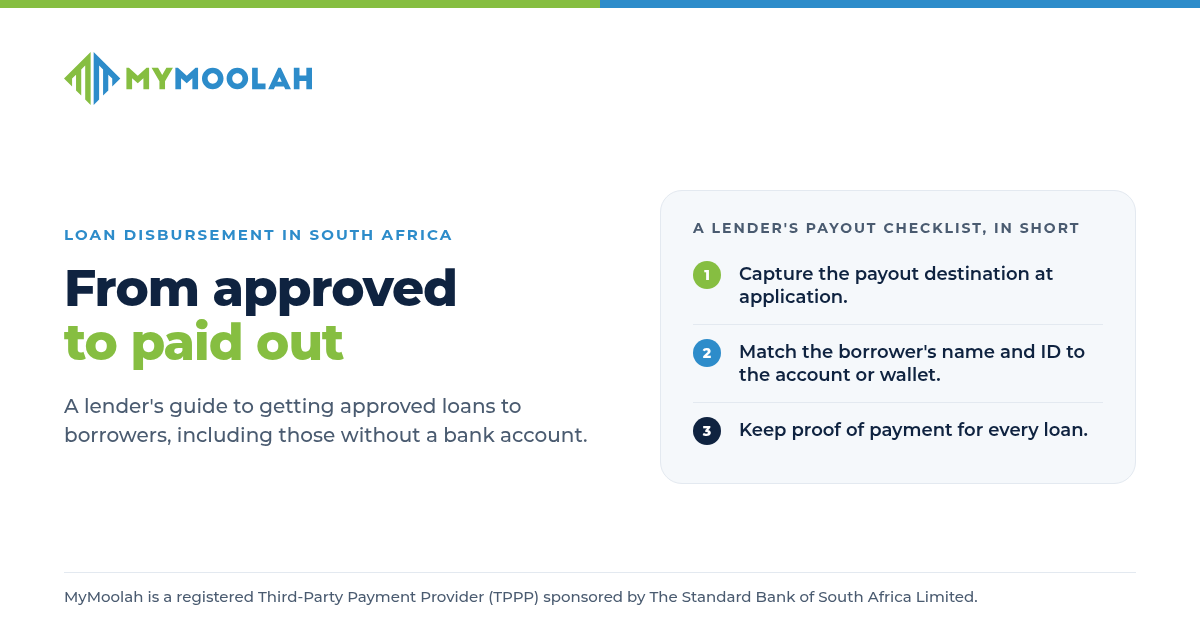
- Capture the payout destination at application, not after approval.
- Match name and ID. The account or wallet should belong to the borrower named in the agreement.
- Fund from one source. One funded float gives finance one balance to reconcile.
- Trigger payouts from your system. Call an API on approval, and use maker-checker controls on any manual batch.
- Keep proof of payment per loan for queries, disputes and audits.
- Plan for failed payments. Decide who is told, how fast you reissue and how you reconcile the return.
How MyMoolah supports loan disbursement
MyMoolah is a registered Third-Party Payment Provider (TPPP) sponsored by The Standard Bank of South Africa Limited. It is not a bank, and it does not grant credit or approve loans.
Lenders pre-fund a MyMoolah float with one EFT from their own bank account, then pay into borrowers’ MyMoolah wallets by portal upload or REST API. Pay into MyMoolah wallets instantly and free of charge, from your funded float, within each recipient’s verification (KYC) limits.
Borrowers open MyMoolah in their phone’s browser; there is no app to download. Until identity checks are complete, a wallet is receive only, capped at R5,000: the holder can’t spend, send or cash out. A loan above the wallet’s current limit can’t be paid in until the borrower’s verification covers it, so check that the borrower has a verified wallet before you disburse. Once verified, the holder can send money to other MyMoolah wallets, buy airtime, data and electricity, pay by QR at participating major retailers, send to a South African bank account, or cash out with a bank-issued cardless withdrawal PIN, where available. Free between MyMoolah wallets, up to R100,000, within your verification (KYC) limits. Fees apply to bank transfers and cash withdrawals.
Related: how to pay casual workers without a bank account.
Information current as at 19 October 2026. This article is industry context, not legal advice. Confirm current product terms and wallet limits before you integrate.
Paying out approved loans? Book a payout demo.
FAQ
What does loan disbursement mean?
It is the payout of an approved loan from the lender to the borrower: the point at which the credit is actually extended.
How long does loan disbursement take in South Africa?
It depends on the lender’s checks and the payment rail. EFT, real-time payments (available through participating banks) and wallet credits settle on different timelines, and EFT is affected by bank cut-offs, weekends and public holidays.
Can a loan be paid into a digital wallet?
Yes, where the lender offers it and the borrower chooses it. The wallet should be in the borrower’s own name, with identity checks (KYC) complete before the loan is paid in.
Are there limits on how much can be paid into a wallet?
Yes. Limits depend on the holder’s verification (KYC) level. Until identity checks are complete, a wallet is receive only, capped at R5,000. Verified wallets have these limits: Tier 1, R5,000 per transaction; Tier 2, R25,000 per transaction and R100,000 a month. Confirm current limits in a payout demo before you integrate.
Who regulates lenders in South Africa?
Credit providers are regulated under the National Credit Act 34 of 2005. The National Credit Regulator registers credit providers and enforces the Act.
Sources
- National Credit Regulator, Consumer Credit Market Report, First Quarter, March 2026 (gross debtors book, short-term credit granted and definitions; accessed 19 October 2026).
- World Bank, Global Findex 2025: account ownership, South Africa, 2024 (accessed 19 October 2026).
- National Credit Act 34 of 2005, sections 81, 92 and 101 (as published in Government Gazette 28619, 15 March 2006; later amendments may apply).
- National Credit Regulator (role and registration of credit providers; accessed 19 October 2026).