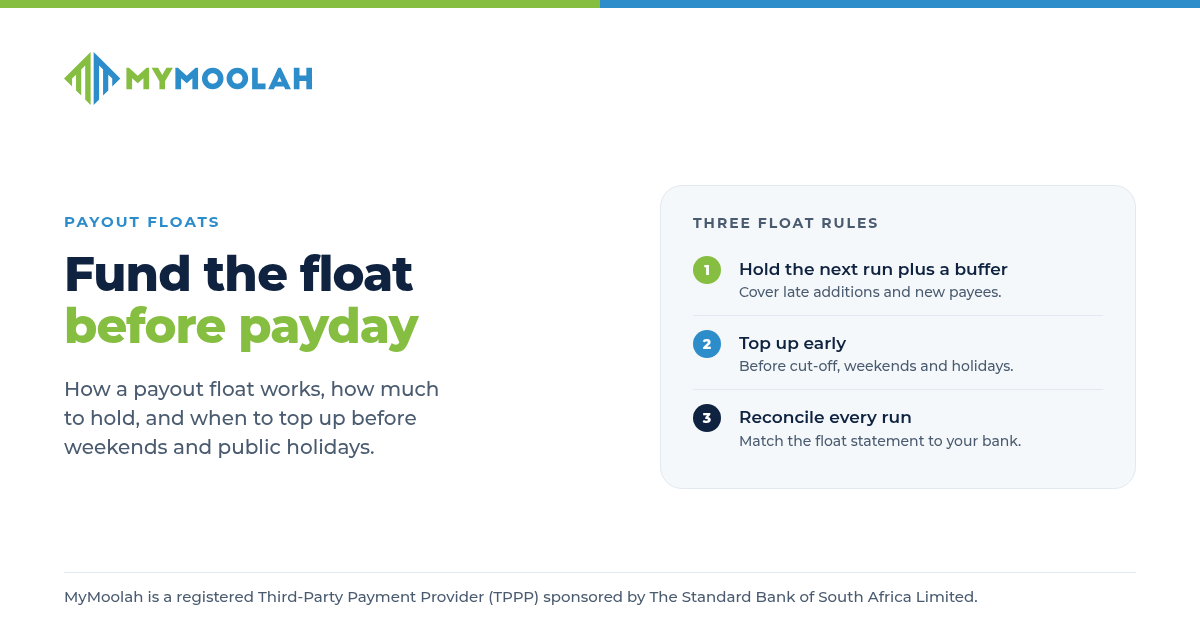

A payout float is money a business deposits in advance with its payout provider, so that payment runs are paid from funds already in place. You fund it by EFT from your own bank account, size it to cover your next run plus a buffer, and decide who may fund it, approve runs and release payments.
This guide is for finance, payroll and operations teams at employers, lenders, insurers and platforms that are moving from bank bulk payments to a disbursement platform. It covers how a float works, how much to keep in it, when to top it up, and the controls around it.
Terms used in this guide
- Float: the balance a business holds with its payout provider to pay people from.
- Top-up: an EFT from your bank account that adds money to the float.
- Deposit reference: the reference your provider gives you, so that each top-up is matched to your float.
- Float statement: a record of the opening balance, every top-up and payout, and the closing balance for a period.
- Buffer: the extra amount you keep above the next run, for late additions and new payees.
How does a payout float work?
- Fund it. Send an EFT from your business bank account to the provider, quoting your deposit reference exactly.
- Wait for the credit. The float goes up once the provider receives the money and matches it to your reference.
- Prepare the run. Upload the payee file in the provider’s portal or send it by API.
- Approve it. A second person checks and approves the run before release.
- Release it. The float goes down by the value of the run, plus any fees taken from the float.
- Reconcile it. Match the float statement to your bank statement and to the run report before the next run.
Why do payout providers ask you to pre-fund?
Pre-funding means the money is in place before any payment leaves. A run doesn’t wait for a bank transfer on payday, and you can see in advance whether there is enough to pay everyone. It also separates two jobs that often get mixed up: moving money from your bank account, which follows bank processing days, and paying people, which follows your own schedule.
How much should you keep in a payout float?
Start with a simple rule: hold enough for the next run, plus a buffer, plus enough to cover any days when a top-up can’t reach you. How that works depends on how you pay.
| How you pay | What to hold | Watch for |
|---|---|---|
| Weekly wages or shifts | The next weekly run plus a buffer | Weeks with a public holiday, and late timesheets |
| Daily payouts to drivers, riders or agents | Your busiest day multiplied by the number of days until the next top-up can arrive | Weekends and long weekends |
| Monthly commission or incentives | The full run, funded a few days before payday | Disputed or late commission lines |
| Claims or loan payouts on demand | Your usual daily value plus a buffer for peaks | Month-end and festive-season peaks |
Review the level every month against the last few runs. A float that is too low delays payments. A float that is far too high ties up cash you could use elsewhere.
When should you top up?
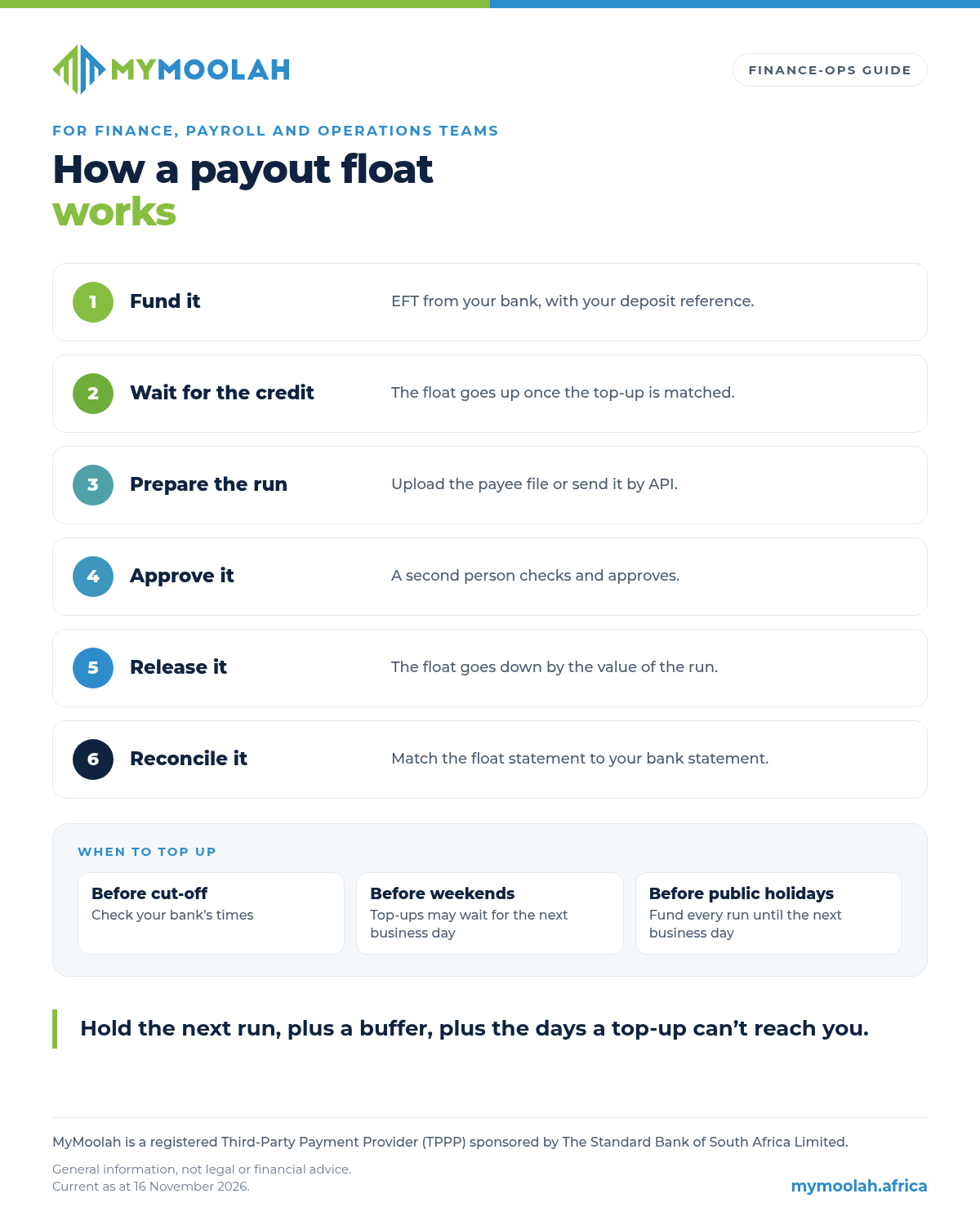
Top up before you need the money, not on the day. Check your bank’s cut-off times. A top-up made after cut-off, on a weekend or on a public holiday may only reach your float on the next business day.
December needs extra care. In 2026, the Day of Reconciliation falls on Wednesday 16 December, Christmas Day on Friday 25 December and the Day of Goodwill on Saturday 26 December, and New Year’s Day 2027 is a Friday. If you pay weekly or daily over that period, fund the float before each holiday for all the runs that fall before the next business day. Our December payout calendar sets out the dates.
Who should control the float?
- Split the roles. The person who sends top-ups from your bank account should not be the person who prepares runs, and the person who approves a run should not be the person who prepared it.
- Use the right reference every time. A top-up with a wrong or missing reference can’t be matched quickly, and the run waits.
- Check the balance daily. Agree a minimum level and who tops up when the float falls below it.
- Plan for urgent top-ups. Decide in advance who can authorise an extra top-up at short notice, and how.
- Reconcile every run. Our guide to reconciling bulk payouts sets out a seven-step routine.
What happens if the float runs short?
A run is paid only from money already in the float. If the float is short, the run can’t be released in full until a top-up arrives. That is why the buffer and the urgent top-up plan matter: they decide whether people are paid on time when a run is bigger than expected.
How does a MyMoolah float work?
MyMoolah is a registered Third-Party Payment Provider (TPPP) sponsored by The Standard Bank of South Africa Limited. Businesses pre-fund a MyMoolah float with an EFT from their own bank account, quoting their own deposit reference, then pay people into MyMoolah wallets by portal upload or REST API. You don’t need a separate EFT for every run while the float covers it. Each run is prepared by one person and approved by another before it is released.
Pay into MyMoolah wallets instantly and free of charge, from your funded float, within each recipient’s verification (KYC) limits.
Wallet payouts can go out on weekends and public holidays, as long as the float covers the run. Every business can download its float statement for its own reconciliation. Each wallet is in the payee’s own name. Until identity checks are complete, a wallet can only receive money, and limits depend on each payee’s verification (KYC) level. Once verified, payees can send money to other MyMoolah wallets, buy airtime, data and electricity, pay by QR at participating major retailers, send to a South African bank account, or cash out with a bank-issued cardless withdrawal PIN, where available. Free between MyMoolah wallets, up to R100,000, within your verification (KYC) limits. Fees apply to bank transfers and cash withdrawals.
Your business can also earn a share of the revenue from the wallets it pays into, under agreed commercial terms.
Information current as at 16 November 2026. This article is general information, not legal, accounting or financial advice. Confirm current product terms and wallet limits before you integrate.
Planning how to fund your payouts? Book a payout demo.
FAQ
What is a payout float?
A payout float is money a business deposits in advance with its payout provider, so that payment runs are paid from funds already in place rather than from a bank transfer on the day.
How do you fund a payout float?
Send an EFT from your business bank account to the provider, quoting the deposit reference it gives you. The float goes up once the provider receives the money and matches it to your reference.
How much money should a payout float hold?
Enough for the next run, plus a buffer for late additions and new payees, plus enough to cover any weekend or public holiday when a top-up may not arrive.
Can wallet payouts go out on a weekend or public holiday?
Yes. MyMoolah wallet payouts can go out on weekends and public holidays, as long as the float covers the run. Top-ups by bank EFT may only arrive on the next business day, so fund the float in advance.
What is a float statement?
It is a record of the float’s opening balance, every top-up and payout, and the closing balance for a period. Every business that pays out through MyMoolah can download its float statement.
Sources
- South African Government, Public holidays in South Africa (2026 and 2027 dates under the Public Holidays Act 36 of 1994; accessed 16 November 2026).