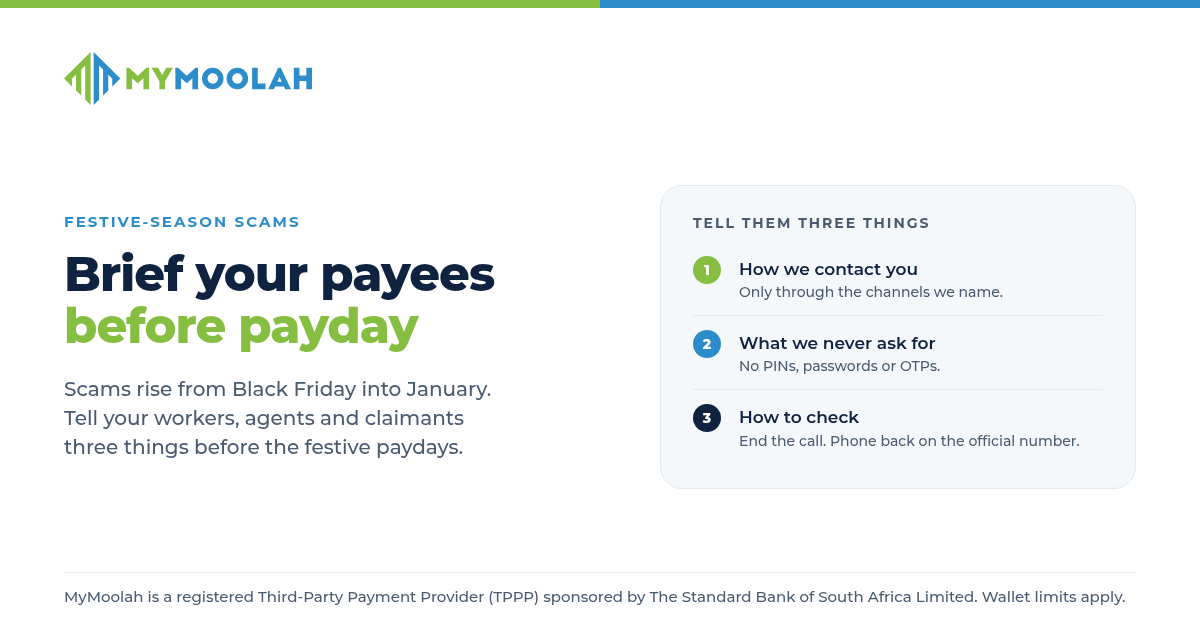

Scams rise from Black Friday into January, and the people you pay are targets as well as shoppers. Before the festive paydays, tell your workers, agents and claimants how you will contact them, what you will never ask for, and how they can check that a message really comes from you. Then stick to it.
The Southern African Fraud Prevention Service (SAFPS) used International Fraud Awareness Week, from 15 to 21 November 2026, to warn about festive-season scams. Black Friday falls on Friday 27 November. This guide is for employers, lenders, insurers and platforms that pay many people. It covers what the warnings say, the messages that reach payees, and a short briefing to send before your next payday.
Terms used in this guide
- Payee: anyone your business pays, such as an employee, agent, driver, claimant or borrower.
- Vishing: a scam phone call, where the caller pretends to be from a bank, insurer, network or government office.
- OTP: a one-time PIN, usually sent by SMS, to approve a login or a payment.
- Payday briefing: a short message to payees that says how you contact them and what you will never ask for.
What are fraud bodies warning about this festive season?
In its 12 November 2026 release, the SAFPS lists fake emails, websites, online marketplaces, pop-ups and adverts; fake delivery messages, in the name of couriers, customs or the Post Office, that ask for an urgent payment; and fake holiday packages and tickets. It singles out vishing. According to SAFPS CEO Manie van Schalkwyk, scam callers pose as banks, insurers, mobile providers or government institutions, “manufacture emergencies”, and pressure people into “sharing one-time PINs, clicking malicious links or transferring funds”.
The South African Banking Risk Information Centre (SABRIC) said in August 2026 that reported digital banking crime losses rose to R2.4 billion in 2025, from about R1.9 billion in 2024. The SAFPS release also cites the Global Anti-Scam Alliance’s 2026 State of Scams in South Africa report. In that survey, 19% suffered financial or data losses, and only 6% reported incidents to the authorities.
Why are the people you pay a target?
Paydays are predictable, and the festive season adds bonuses and travel. As Business Explainer reported on 19 November, the SAFPS and SABRIC say scams intensify around Black Friday, when many people have received year-end bonuses. In January, the focus shifts to people under financial pressure, with fake loan offers that ask for a fee before the money is released.
Scammers also use real personal details to sound genuine. A message that names your business, the payee’s manager or their payday is easy to believe. Your payees can’t check every message, but they can follow a few simple rules if you give them those rules in advance.
| Message a payee might get | What it asks for | What to tell your payees |
|---|---|---|
| A call “from the bank” or “from your wallet provider” about suspicious activity | An OTP, PIN or password | End the call. Phone back on the official number. Never share a PIN, password or OTP. |
| A message in your company’s name about a bonus or a pay problem | A click on a link, or new payment details | We only contact you through the channels we have named, and we never change your payment details by message. |
| A delivery or customs message | A small fee before the parcel is released | Don’t pay from a link. Check with the shop or courier directly. |
| An “approved loan” you never applied for | A fee before the money is paid out | A request for a fee to release money is a warning sign. |
| A request to install an app or file | Access to the phone | Don’t install anything sent in a message. |
What should you tell the people you pay before payday?
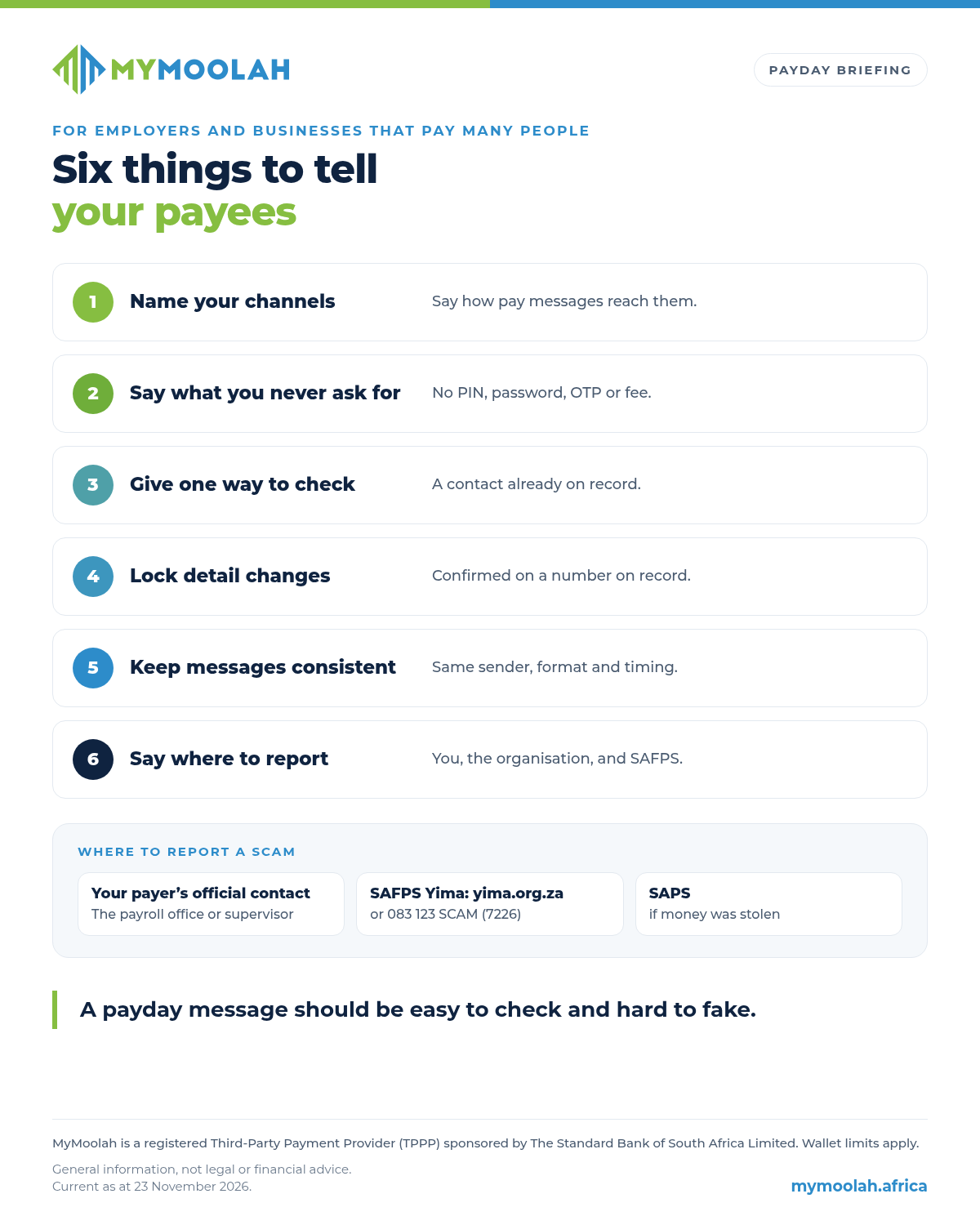
Send a short payday briefing before the first festive payday, and repeat it in January. Keep it to six points:
- Name your channels. Say exactly how you send pay messages, for example payslips by email or notices from one company number, and that this won’t change by message.
- Say what you will never ask for. You will never ask for a PIN, password or OTP, and never ask anyone to pay a fee to receive their pay.
- Give one way to check. Name a contact already on record, such as the payroll office or a supervisor. The SAFPS advice for suspicious calls is simple: “just say goodbye and end the call”, then contact the organisation through its official channels.
- Lock payment-detail changes. Explain that a change to where someone is paid only happens through your normal process, and that you will confirm it on a number already on record.
- Keep pay messages consistent. Use the same format, sender and timing every payday, so that a fake stands out.
- Say where to report. Tell payees to report anything suspicious to you, to the organisation named in the message, and on the SAFPS Yima platform at yima.org.za or 083 123 SCAM (7226). If money was stolen, they should also report it to SAPS.
Our December payout calendar shows when the festive paydays fall, so you can time the briefing.
What should your own finance team watch for?
The SAFPS says scam calls also target “corporate employees with access to financial systems”. Over the holidays, teams are often smaller, and rushed approvals become more likely. Hold to the same rules you set for payees: no change to a payee’s details without a call-back to a number already on record, no unscheduled run released on the strength of a phone call or an email, and a second person to approve every run. Our guide to preventing payout fraud sets out seven controls.
How do MyMoolah wallet payouts fit?
MyMoolah is a registered Third-Party Payment Provider (TPPP) sponsored by The Standard Bank of South Africa Limited. Wallet limits apply. Businesses fund a MyMoolah float with an EFT from their own bank account, then pay people into MyMoolah wallets by portal upload or REST API, as our guide to disbursement platforms describes. Each payout run is prepared by one person and approved by another before it is released.
Pay into MyMoolah wallets instantly and free of charge, from your funded float, within each recipient’s verification (KYC) limits.
Three facts make the payday briefing easier for payees who are paid into a MyMoolah wallet. MyMoolah will never ask for your PIN, password or OTP. There is no MyMoolah app to download. The wallet opens in the phone’s browser at wallet.mymoolah.africa, so a message asking someone to install a MyMoolah app didn’t come from us. And payees should only use the official addresses, mymoolah.africa and wallet.mymoolah.africa. Free between MyMoolah wallets, up to R100,000, within your verification (KYC) limits. Fees apply to bank transfers and cash withdrawals.
Information current as at 23 November 2026. This article is general information, not legal or financial advice.
Paying people over the festive season? Book a payout demo.
FAQ
Which scams increase over the festive season?
The SAFPS warns about fake online shops, adverts and marketplaces, fake delivery and customs messages that ask for payment, fake holiday bookings, and calls from people posing as banks, insurers, mobile providers or government offices.
Does MyMoolah ever ask for a PIN, password or OTP?
No. MyMoolah will never ask for your PIN, password or OTP. If someone asks for one, end the conversation and contact MyMoolah through the details on mymoolah.africa.
How can a payee check that a payday message is real?
By using a contact already on record, such as the payroll office or a supervisor, rather than a number or link in the message. A real employer or payer will not mind the check.
Where do you report a scam in South Africa?
Report it to the organisation involved and on the SAFPS Yima platform at yima.org.za or 083 123 SCAM (7226). If money was stolen, also report it to SAPS.
Should businesses warn the people they pay about scams?
Yes. A short briefing before high-risk periods, such as the festive season and January, tells payees how you contact them and what you will never ask for, so fake messages are easier to spot.
Sources
- Southern African Fraud Prevention Service, International Fraud Awareness Week 2026: SAFPS Warns of Festive Season Risks (press release, 12 November 2026, citing the Global Anti-Scam Alliance’s 2026 State of Scams in South Africa report; accessed 23 November 2026).
- SABRIC, SABRIC Release the 2025 Annual Banking Crime Statistics Report (August 2026; accessed 23 November 2026).
- Business Explainer, Scammers Ready to Spoil Your Festive Season (19 November 2026; accessed 23 November 2026).