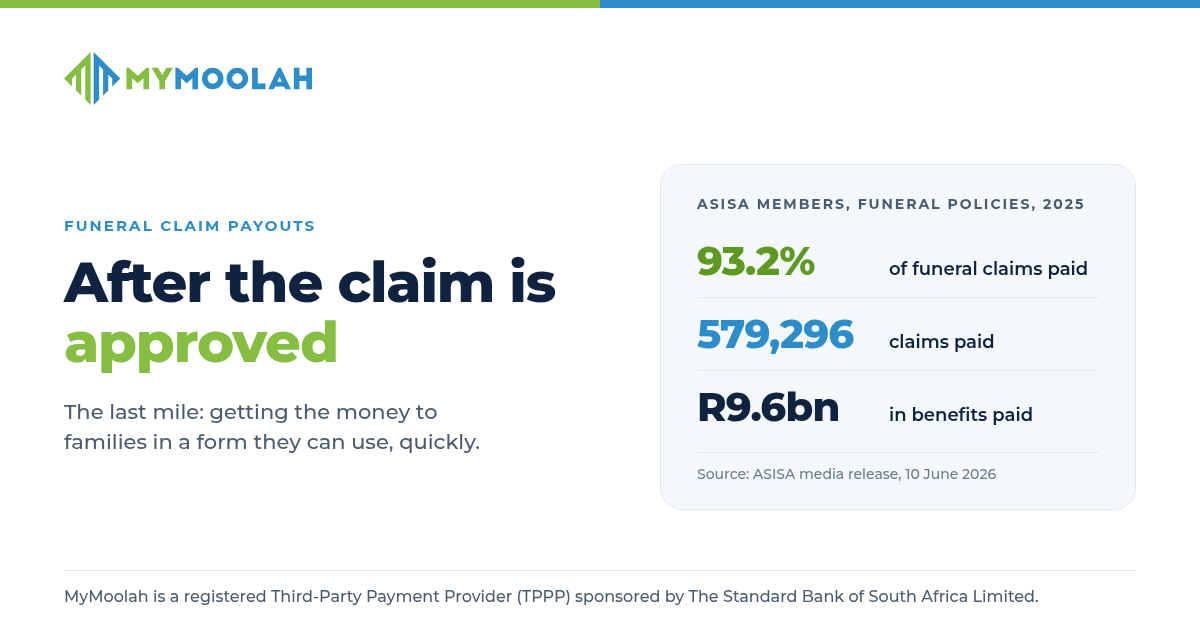

Most funeral claims are paid. The Association for Savings and Investment South Africa (ASISA) reports that its life insurance members paid 93.2% of claims on funeral policies in 2025: 579,296 claims, worth R9.6 billion in benefits. Source: ASISA, “Life insurers settled 94.1% of all death claims in 2025”, 10 June 2026.
Those figures measure the claim decision. A grieving family measures something else: whether the money arrives in a form they can use before the funeral. For insurers, administrators and burial societies, the step between “approved” and “usable” is where returned payments, delays and support calls build up. This article looks at where that last mile breaks and what a claims team can check.
What the ASISA figures tell a claims team
The 2025 numbers describe a growing book. ASISA members paid 579,296 funeral claims in 2025, up from 530,045 in 2024, and the value paid rose from R7.3 billion to R9.6 billion. The payout rate eased slightly, from 94.7% to 93.2%. ASISA gives waiting periods, fraud and unpaid premiums as the main reasons funeral claims are declined, and describes funeral policies as designed to pay out quickly and without hassle.
In operational terms, 579,296 paid claims is close to 1,600 a day, and R9.6 billion spread across them is roughly R16,500 a claim. These are simple averages worked out from ASISA’s totals, not figures ASISA publishes. They still make the point: every one of those claims needs a destination that works on the first attempt.
The statistics cover ASISA’s life insurance members. Burial societies and smaller schemes sit outside them, but they pay the same families and face the same last mile.
Where approved claims stall
Once a claim is approved, sending the payment is rarely the hard part. The trouble sits around it.
- The beneficiary has no bank account in their own name, or has one they no longer use. Claim forms commonly ask for proof of the account the benefit will be paid into, such as a bank confirmation letter, and getting one is another errand. A payment to a closed or dormant account can be returned, and the correction takes time while funeral costs are already due.
- Bank details captured under pressure, by a relative or over the phone, are easy to get wrong. Each failed payment means a call, a correction and another payment run.
- The payment succeeds, but the beneficiary must travel to draw cash or wait for someone to help them get to it.
- The beneficiary cannot be found at all. ASISA’s Guideline on Unclaimed Assets lists “named beneficiaries cannot be located where a risk benefit claim has been admitted” as one of the events that should prompt members to start tracing. Source: ASISA Guideline on Unclaimed Assets, last updated 17 July 2024. An approved claim that never reaches the family is the far end of the same problem.
None of this shows up in a payout-rate statistic. It shows up later, in returned-payment reports and in the complaints queue.
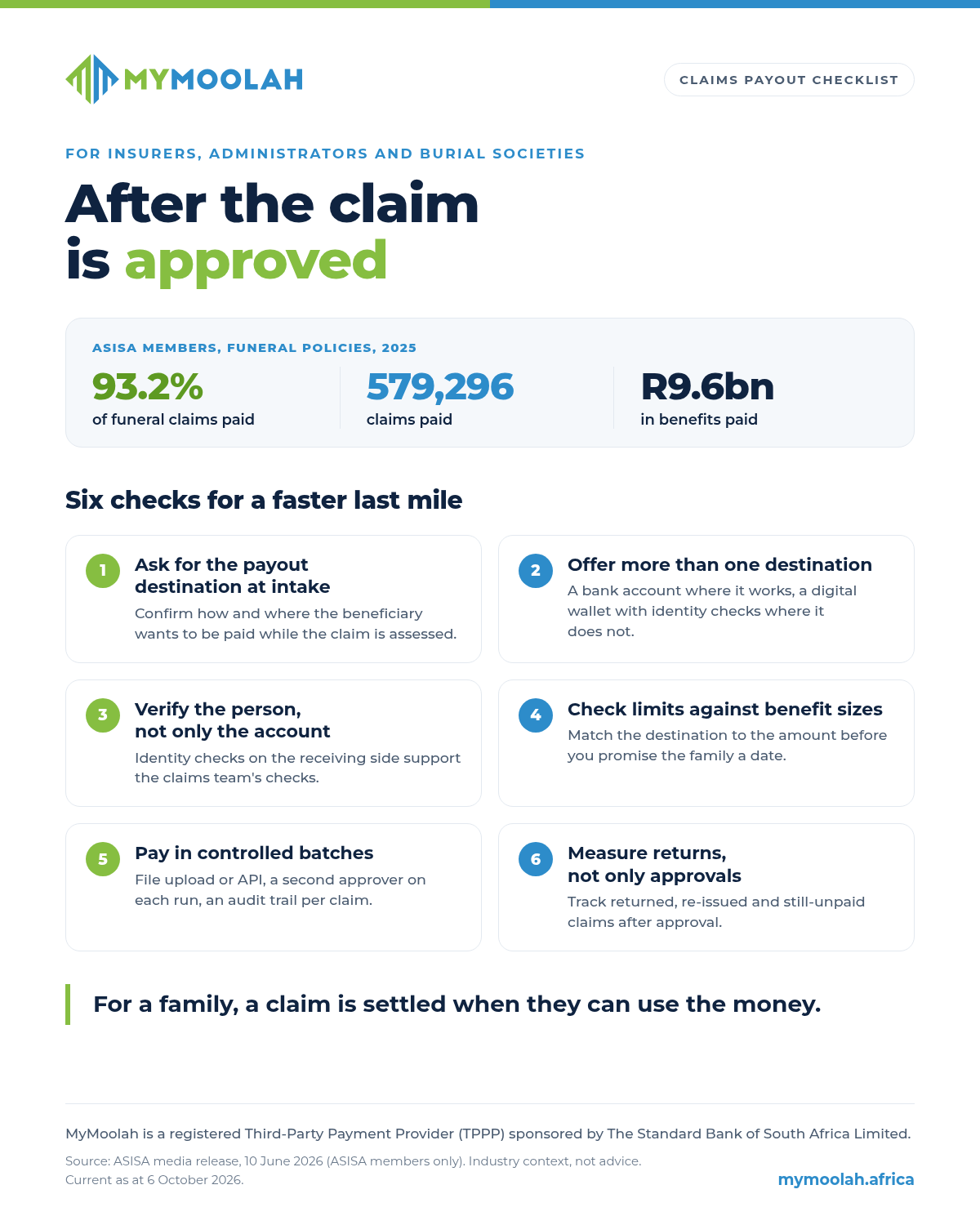
Six checks for a faster last mile
- Ask for the payout destination at intake. Confirm how and where the beneficiary wants to be paid, and confirm their mobile number, while the claim is still being assessed. Leaving it until after approval adds a step at the worst moment.
- Offer more than one destination. A bank account works well when the beneficiary has one and uses it. For those who do not, a second option such as a digital wallet with identity checks means the family does not have to wait for a bank account to be opened or fixed.
- Verify the person, not only the account. Know who is receiving the money. Identity checks on the receiving side support the checks the claims team has already done.
- Check limits against benefit sizes. Wallets and some accounts have balance and transaction limits. Match the destination to the benefit amount before you promise the family a date.
- Pay in controlled batches. Whether you upload a file or call an API, keep a second approver on each run, an audit trail per claim and a reconciliation report that finance can use.
- Measure returns, not only approvals. Track returned payments, re-issued payments and claims still unpaid after approval. Approval turnaround on its own does not tell you whether families were paid.
Where a wallet fits
MyMoolah is a registered Third-Party Payment Provider (TPPP) sponsored by The Standard Bank of South Africa Limited. It is not a bank.
For organisations that pay many people, MyMoolah handles payouts into MyMoolah digital wallets. The payer funds a float with one EFT from its own bank account, then pays beneficiaries by portal upload or REST API. Beneficiaries verify their identity in the wallet before they can spend. They can then send money to other MyMoolah wallets, buy airtime, data and electricity, pay by QR at participating shops, or withdraw cash at ATMs and major retailers. Wallet limits apply.
For a funeral claim, this gives a beneficiary without a working bank account a way to receive the benefit on their phone and pay for what is needed, or to draw cash. It does not replace a bank payment where the beneficiary has an account they use. It gives the claims team a second destination for the cases that would otherwise be returned, delayed or left unclaimed.
What this does not change
MyMoolah does not assess, approve or administer claims. Insurers and administrators keep their own obligations to identify the right beneficiary and to treat customers fairly. A better destination does not shorten a waiting period or change a claim decision. It matters after the decision, when the money has to reach the family.
Information current as at 6 October 2026. Claims figures are as published by ASISA for its members. Product features and wallet limits can change; confirm current terms before you integrate.
Pay funeral claims? Talk to us about claim payouts for beneficiaries without a usable bank account. Book a payout demo.
Sources
- ASISA media release, “Life insurers settled 94.1% of all death claims in 2025”, 10 June 2026 (ASISA Claims Payout Statistics: 2024 to 2025).
- ASISA Guideline on Unclaimed Assets, first published 1 June 2013, last updated 17 July 2024 (clause 4.4.3).