
If your organisation pays hundreds or thousands of people — players, members, claimants, workers, beneficiaries — payouts are not a side process. They are part of the product. Delayed or returned payments create support tickets. Money that lands in an account nobody uses creates “where is my money?” calls. Choosing the wrong rail creates cost that never shows on the customer journey map.
This week, that operational problem sits next to a regulatory one. South Africa’s payment-system rules are being rewritten in public view. Businesses that disburse at scale should treat that as a due-diligence moment, not a spectator sport.
What changed in the last few weeks
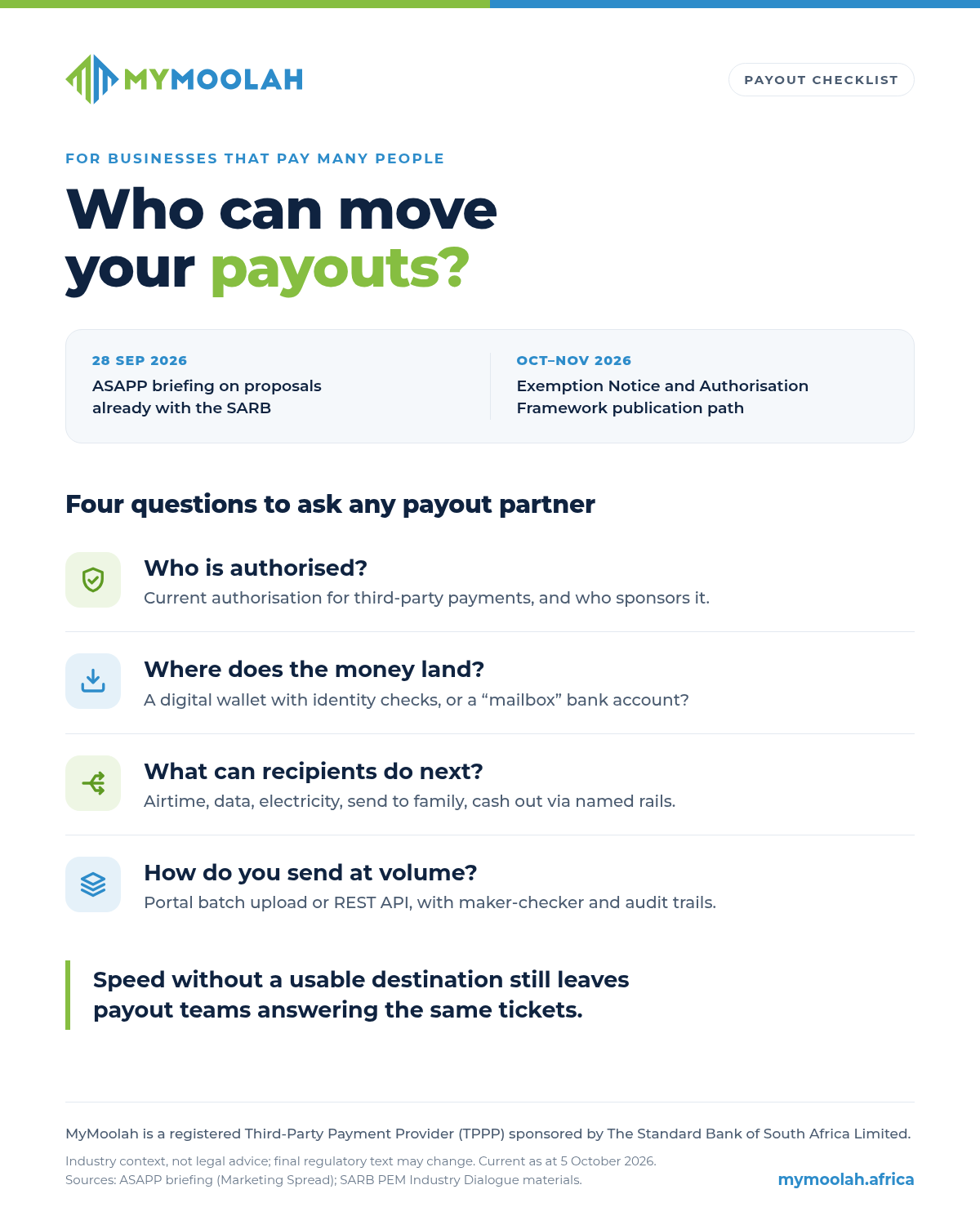
On 28 September 2026, the Association of South African Payment Providers (ASAPP) held a strategy session and media briefing in Sandton. The association described practical proposals already with the South African Reserve Bank (SARB) — including work on interchange costs and a proposal on PayShap merchant acceptance and interoperability — and confirmed engagement on the Banks Act Exemption Notice and the Authorisation Framework that will shape how non-bank payment activities are authorised. Source: Marketing Spread report on the ASAPP briefing.
ASAPP also noted that on 2 September 2026 the last of PASA’s functions transferred to the SARB and PayInc. Industry governance of the National Payment System (NPS) is moving. Separately, SARB Payments Ecosystem Modernisation materials point to finalisation and publication of the Exemption Notice and Authorisation Framework on an October–November 2026 path. Context: SME South Africa on the NPS and Authorisation Framework; SARB PEM Industry Dialogue materials (September 2026).
None of that is legal advice, and the final Gazette text may still change. The useful point for a finance, payments or operations lead is simpler: the list of who may lawfully move money — and on what terms — is being clarified. That clarification matters when you pick a disbursement partner.
Why enterprise payers should care
ASAPP’s briefing also restated an inclusion reality many payout teams already know from support queues. FinMark Trust’s FinScope research, as cited in that coverage, puts roughly 9.5 million South Africans earning through the informal economy, and notes that millions of banked adults still use an account mainly to receive money and withdraw it. Source: same Marketing Spread / ASAPP briefing (FinScope figures as reported there).
For a gaming operator paying winnings, a loyalty programme paying rewards, a stokvel paying members, an NGO paying stipends, an employer paying casual staff, or an insurer paying claims, that pattern has a name: the payment “succeeds” on paper, then fails in real life. The recipient cannot buy airtime, settle an undertaker, or send money home without another trip, another fee, or another delay.
Faster rails help. Destination design helps more. Instant payment volume on PayShap has grown sharply — the SARB’s NPS Regulatory and Oversight Report for 2025/26 records 725 million successful PayShap transactions totalling R659 billion since launch, with further work planned on fraud monitoring, QR+ and broader use cases. Source: SARB NPS Regulatory and Oversight Report 2025-2026. Speed without a usable destination still leaves payout teams answering the same tickets.
A practical checklist before you choose a payout partner
Use the reform window as a reason to ask harder questions. Soft B2B diligence beats a glossy feature list.
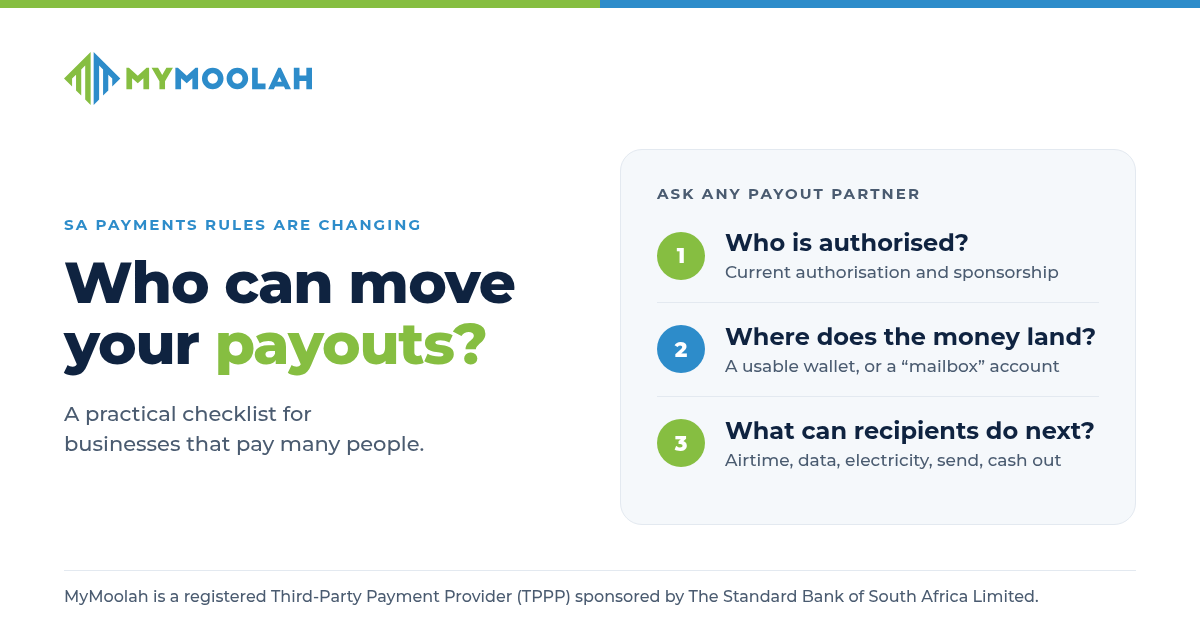
- Authorisation and sponsorship. Ask how the provider is authorised to conduct third-party payment activity today, and who sponsors or oversees that activity. Prefer clear, current wording over slogans.
- How the money lands. Can recipients receive into a digital wallet with identity checks, or only into a bank account that may be “mailbox” in practice?
- What recipients can do next. Can they buy prepaid airtime, data or electricity, send to family, or cash out through live, named rails — without opening another product first?
- How you send at volume. Portal batch upload, REST API, or both. Maker-checker and audit trails matter as much as latency slides.
- Cost honesty. Separate the cost of funding a float, the cost of disbursing into wallets, and the cost of paying out to other banks. Avoid “cheapest” claims; ask for the fee line you will actually see.
- Commercial alignment. Some models treat every payout as a cost centre. Others let the payer earn from wallet activity after disbursement. Ask which model you are buying — without chasing percentage rumour.
Where MyMoolah sits today
MyMoolah is a registered Third-Party Payment Provider (TPPP) sponsored by The Standard Bank of South Africa Limited. It is not a bank and does not take deposits.
For businesses that pay many people, the MyMoolah Treasury Platform supports disbursements into MyMoolah digital wallets via channel-partner portal upload or REST API. Recipients can use the wallet for everyday money moves: free transfers between MyMoolah wallets up to R50,000; one flat R5.50 for instant payments to other South African bank accounts; prepaid airtime, data and electricity; and cash-out through the live cardless PIN options shown in the wallet (Absa CashSend and Nedbank Cardless).
On the commercial side, MyMoolah’s B2B model is built so payout partners can earn from every wallet they pay into — a soft shift from “pay to pay out” toward treating disbursements as more than a pure cost. Hard commercial terms belong in a partner conversation, not in a public percentage.
What this is not
This article is not a prediction of the final Authorisation Framework text, not legal advice, and not a claim that regulation alone fixes failed payouts. It is also not a consumer story about ATM networks. Cash still matters for many South Africans; the enterprise question for Tuesday morning is who moves the money you already decided to pay — and whether the person on the other end can use it.
Information current as at 5 October 2026. Regulatory instruments and product features can change; confirm the live wallet and partner terms before you transact or integrate.
Businesses: explore payout partnership options at mymoolah.africa. Recipients: open a wallet at www.wallet.mymoolah.africa.